The passing of Naguib Mahfouz is a great loss to Egypt first but also to the rest of the Arab world. Here is fitting eulogy of Mahfouz by the Moroccan-French writer and intellectual Tahar Ben Jelloun:
Man in the Middle
By TAHAR BEN JELLOUN
New York Time, Op-Ed, Published: September 3, 2006
Tangiers, Morocco
INSTALLED at his regular table at his regular cafe in Cairo, a daily rendezvous that only illness could cancel, Naguib Mahfouz observed the anonymous crowd swarming the city streets with an eye that was tolerant, humane, sometimes ironic or arch, but never malicious. He was the voice and the memory of these lives, complex, small, grandiose, magnificent or modest — from the students who came to consult him to the waiters who served him his habitual coffee.
Balzac said that because the novel is the private history of nations, a real novelist must be able to plumb the depths of society. Mr. Mahfouz fit this description perfectly. You can’t understand Egypt without Mr. Mahfouz — without his characters, with whom every reader, Arab or not, can identify. In the days since his death, many have noted how Mr. Mahfouz helped Western readers understand the Arab world. But perhaps even more important, he helped the Arab world understand itself.
Before Mr. Mahfouz, the novel as literature — literature as map to understanding — was not part of Arab culture. In fact, until the beginning of the 20th century, Arabs didn’t write novels, in large measure because Arab society didn’t recognize the individual. Only in 1914, with “Zainab,” by Hussein Haykal, published as a serial, did what is considered the first real Arabic novel appear.
And it really wasn’t until the 1950’s, and the publication of Mr. Mahfouz’s “Cairo Trilogy,” that the Arab novel arrived as a major genre of literature. In the trilogy — “Palace Walk,’’ “Palace of Desire” and “Sugar Street” — Mr. Mahfouz described the lives of three generations of a family that stood in for a country making an epic transition of its own, from tradition to a halting form of modernity.
From a Western perspective, it is difficult, I imagine, to understand the cultural power these novels exerted. Even before Mr. Mahfouz won the Nobel Prize in 1988, the trilogy had the effect of liberating a generation of Arab writers. Young writers like Haydar Haydar and Fadhil al-Azzawi didn’t write like Mr. Mahfouz, but his books and his stature gave them the confidence to persevere in examining everyday life.
In his own generation, there is Yahya Haqqi, whose 1954 work “Good Morning!,” about an isolated Egyptian village’s passage into modern life, is a milestone in the history of the Arabic novel. There are also Taha Hussein and Tawfik al-Hakim, two important observers of their society who critiqued Western culture.
Like the characters in his novels, Mr. Mahfouz found himself at times trapped between tradition and modernity. His 1959 book “Children of the Alley,” which was not anti-Islamic but took liberties with the histories of the founders of the three monotheistic religions, was condemned by clerics, and after they complained to President Gamel Abdel Nasser, Mr. Mahfouz promised to not allow its future publication. (To Mr. Mahfouz’s dismay, a pirated edition of the book showed up on the sidewalks of Cairo.)
His relationship with Islamic militants continued to be an uneasy one. In 1994, they tried to stab him to death. Still, he had no hatred for them. He knew that their actions were dictated by ignorance, and as he said from his hospital bed, they had nothing to do with Islam. He hated conflict and supported the 1979 peace accords with Israel, a stance that led to boycotts or bans of his books in some Arab nations.
Mr. Mahfouz tried all styles of writing, including experimental novels. This amused him. His language, classical and conservative at first, became more inventive, incorporating what he heard in his neighborhood, which he never left. He didn’t travel. It’s said that he left Cairo once or twice, no more. He was an immobile voyager, an explorer of the human soul seated in a cafe.
It’s also been said that Mr. Mahfouz was a realistic novelist. This is not the case. Realism doesn’t exist, because life, especially life in Cairo, is itself a fiction, unfathomable, inexhaustible, where drama jostles with comedy, where tears run from joy or chagrin. Mr. Mahfouz didn’t have to invent situations or characters; it was sufficient for him to observe the people around him.
In “Sugar Street,” the death of a main character is signaled in a few words: “The master has left the house.” The same words apply today, to Naguib Mahfouz, master of the Arabic novel.
Tahar Ben Jelloun, the winner of France’s Goncourt Prize for “The Sacred Night,’’ is the author, most recently, of “The Last Friend.’’ This article was translated by The Times from the French.
Sunday, September 03, 2006


Tuesday, August 29, 2006
The Long View: Lebanon '82-'06
Context, historical context, is crucial in our understanding the events of the last six weeks. In this dichotomous post 9/11 world everyone is taking sides: you are either with us or you are the enemy. Everyone becomes an uncompromising ideologue, unwilling to listen to reason if it does not fit their preconceived notion of reality regardless of context, history or precedent; the world is black and white. This simple-minded approach never works especially in a place with as many shades of grey as Lebanon.
This brings me to the photographs I took twenty four years ago. They are from late 1982, and for those of us old enough to remember that time vividly, it carries eerie parallels to the recent events. The photographs are taken in the old city center, still devastated by the civil war. The subjects are kids from South Lebanon, refugees in their own land taking shelter with their families amid the ruins of the city center.

I wonder about what has become of these kids. Did they go back to the South? Did they suffer another tragedy, losing homes or family members yet again? Are they still living?

The boys are standing in front what is now the Grand Serail, now the seat of the Government, where Sanioura recently received Kofi Annan.

Posing in front of Roman columns, which are now surrounded by numerous high-end restaurants and shops.
So why resurrect these old photographs? Well, they remind me of who the victims of this current war are. It is those same kids, now adults, victimized yet again. So it behooves the Lebanese who oppose Hizbollah to take the long view when trying to resolve Lebanon's internal political crisis. The Shia community of the South has suffered immensely over the past 30 years because of war as well as the neglect of the central government. I too would like to see Hizbollah disarm and disolve its state within a state. However, dismissing one of the Shia's main representatives as stooges of Syria and Iran and the conflict as the "war of others" at the expense of the Lebanese is simplistic and counterproductive. There are festering unresolved issues dating back to the civil war that many Lebanese chose to ignore for too long . The Lebanese government has to work hard to win back the support of a constituency that it has long neglected and whose loyalty it has forfeited to Hizbollah. An honest, fair accord between the Lebanese communities is the best guarantee against any more Harb al-Akhareen at the expense of Lebanon and its people.
This brings me to the photographs I took twenty four years ago. They are from late 1982, and for those of us old enough to remember that time vividly, it carries eerie parallels to the recent events. The photographs are taken in the old city center, still devastated by the civil war. The subjects are kids from South Lebanon, refugees in their own land taking shelter with their families amid the ruins of the city center.

I wonder about what has become of these kids. Did they go back to the South? Did they suffer another tragedy, losing homes or family members yet again? Are they still living?
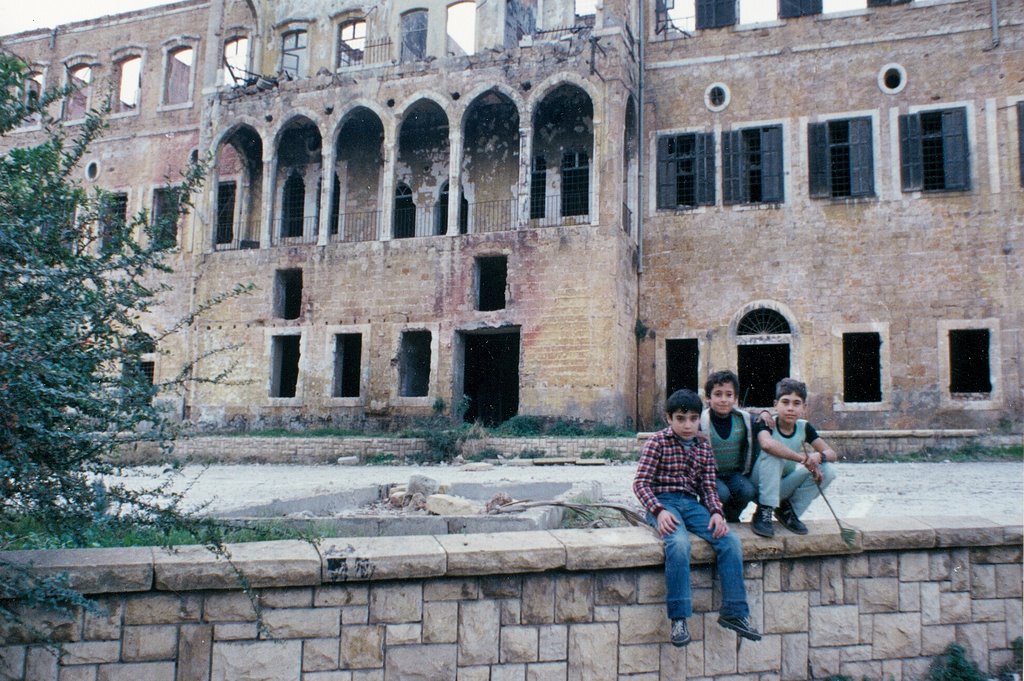
The boys are standing in front what is now the Grand Serail, now the seat of the Government, where Sanioura recently received Kofi Annan.
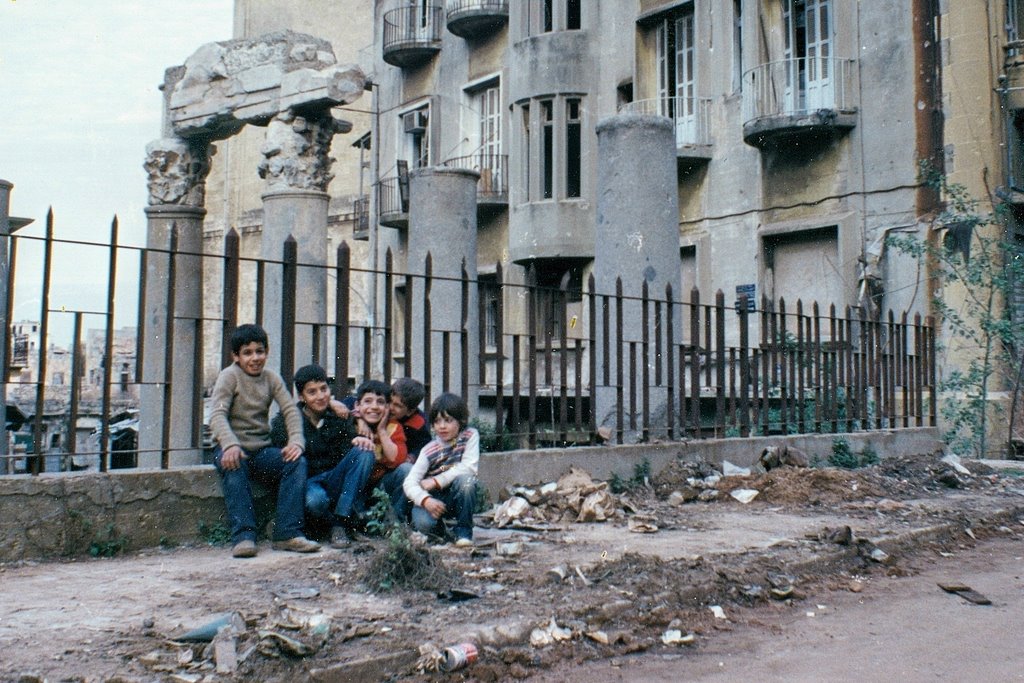
Posing in front of Roman columns, which are now surrounded by numerous high-end restaurants and shops.
So why resurrect these old photographs? Well, they remind me of who the victims of this current war are. It is those same kids, now adults, victimized yet again. So it behooves the Lebanese who oppose Hizbollah to take the long view when trying to resolve Lebanon's internal political crisis. The Shia community of the South has suffered immensely over the past 30 years because of war as well as the neglect of the central government. I too would like to see Hizbollah disarm and disolve its state within a state. However, dismissing one of the Shia's main representatives as stooges of Syria and Iran and the conflict as the "war of others" at the expense of the Lebanese is simplistic and counterproductive. There are festering unresolved issues dating back to the civil war that many Lebanese chose to ignore for too long . The Lebanese government has to work hard to win back the support of a constituency that it has long neglected and whose loyalty it has forfeited to Hizbollah. An honest, fair accord between the Lebanese communities is the best guarantee against any more Harb al-Akhareen at the expense of Lebanon and its people.
Saturday, August 26, 2006
Arab Liberals & ME Transparent
The following is an interview by Mihcael Young of Pierre Akel who hosts Middle East Transparent, a forum for Arab liberals. I found the interview instructive about who the various liberal and Islamic reformist writers are and their country of origin. Akel makes special of the large number of Syrian writers who contribute to the forum.
Wednesday, August 23, 2006
The Gracious Syrian Citizens
During the darkest and ugliest days of the recent conflict between Hizbollah and Israel, there was a small but bright ray of hope that shone from of all places, Syria. No, it was not the result of anything the regime or its cronies did, as nothing illuminating ever comes from them. I am talking about the graciousness and generosity with which the people of Syria pitched in to help their displaced Lebanese neighbors.
I must admit that when I first heard the stories, I suspected that it was the regime mobilizing for propaganda purposes. I was wrong. I should have known better that an insecure, paranoid, vindictive regime is incapable of thinking creatively in this way. From personal stories that I heard, "Official Syria" did not make it easy for Lebanese crossing the border and hampered relief going back in.
In fact the initial and bulk of the aid to refugees was the work of private citizens, civil society groups and private businesses. The stories abound of Syrians of all strata of society pitching in generously to help (Here, here, and here ).
As a Syrian, this is feel-good story at a time when there is little to cheer about and I am very proud of my compatriots. However, I think there is more to this story than meets the eye. Critics of the Syrian regime often attribute the regime's longevity to the passive, cowed attitudes of the Syrian citizens that are incapable of acting in the public sphere without direction from the government. This attitude, it is said would also impede the move towards reform.
Well, guess what? The citizens of Syria have proved the critics wrong. The citizens of Syria can think and act for themselves; they can mobilize their civil society groups to work effectively for a common cause. To me, this reflects a certain maturity among the citizens in their perception of their roles and responsibilities for the greater good of society, a maturity that I am not sure was present a generation ago. Now it is true that mobilizing to help Lebanese refugees is not like mobilizing to demand reform. However, the mere fact that citizens are capable of organizing independently on a large scale is significant. It makes me a little more hopeful about the stability of Syrian society should (when?) major changes happen at the top.
I must admit that when I first heard the stories, I suspected that it was the regime mobilizing for propaganda purposes. I was wrong. I should have known better that an insecure, paranoid, vindictive regime is incapable of thinking creatively in this way. From personal stories that I heard, "Official Syria" did not make it easy for Lebanese crossing the border and hampered relief going back in.
In fact the initial and bulk of the aid to refugees was the work of private citizens, civil society groups and private businesses. The stories abound of Syrians of all strata of society pitching in generously to help (Here, here, and here ).
As a Syrian, this is feel-good story at a time when there is little to cheer about and I am very proud of my compatriots. However, I think there is more to this story than meets the eye. Critics of the Syrian regime often attribute the regime's longevity to the passive, cowed attitudes of the Syrian citizens that are incapable of acting in the public sphere without direction from the government. This attitude, it is said would also impede the move towards reform.
Well, guess what? The citizens of Syria have proved the critics wrong. The citizens of Syria can think and act for themselves; they can mobilize their civil society groups to work effectively for a common cause. To me, this reflects a certain maturity among the citizens in their perception of their roles and responsibilities for the greater good of society, a maturity that I am not sure was present a generation ago. Now it is true that mobilizing to help Lebanese refugees is not like mobilizing to demand reform. However, the mere fact that citizens are capable of organizing independently on a large scale is significant. It makes me a little more hopeful about the stability of Syrian society should (when?) major changes happen at the top.
The Mufti Answers Bashar
Here is a quote from the Mufti of Mount Lebanon, Mohamed Ali Al-Jouzo from Al Safir newspaper as it appeared in ME Transparent (My translation is below):
"Some want to steal victory at the expense of the blood, tears and destruction that has befallen Lebanon. Failed Lebanese politicians have made themselves partners and fathers of this victory and, as usual, have traded in it as a commodity. The heir of those who sold the Golan and Lebanon to Israel, the politically immature president has become the father of victory in Lebanon. Ahmadinajad in Iran has become the father of victory in Lebanon. We say to all of them, Lebanon and the people of Lebanon and the blood of the Lebanese and the tragedies of the Lebanese are not for rent or sale. The people of Lebanon alone have paid a heavy price; Lebanon from end to end has paid a heavy price. The Lebanese people alone have the right to reap the fruits of this sacrifice and the fruit of this sacrifice is the establishment of a free and independent state. No one, after today, can kidnap Lebanon and sell it in the market of regional and international conflicts."
"Some want to steal victory at the expense of the blood, tears and destruction that has befallen Lebanon. Failed Lebanese politicians have made themselves partners and fathers of this victory and, as usual, have traded in it as a commodity. The heir of those who sold the Golan and Lebanon to Israel, the politically immature president has become the father of victory in Lebanon. Ahmadinajad in Iran has become the father of victory in Lebanon. We say to all of them, Lebanon and the people of Lebanon and the blood of the Lebanese and the tragedies of the Lebanese are not for rent or sale. The people of Lebanon alone have paid a heavy price; Lebanon from end to end has paid a heavy price. The Lebanese people alone have the right to reap the fruits of this sacrifice and the fruit of this sacrifice is the establishment of a free and independent state. No one, after today, can kidnap Lebanon and sell it in the market of regional and international conflicts."
Sunday, August 20, 2006
Why is Israel Offering to Talk to Syria?
I am not much for conspiracy theories but the post-war regional machinations is leaving me scratching my head for explanations. I am referring specifically at Israel's appointment of Yakov Dayan as project manager for possible negotiations with Syria. One starts to wonder whether whether the war was not only premeditated but whether it was a package deal.
Let's quickly recount the facts:
Let's quickly recount the facts:
- Hezbollah captures 2 Israeli soldiers on July 12th.
- Israel, decides within a couple of hours to launch an all out assault and Hezbollah and Lebanon.
- The US cheers the Israelis on and blocks all attempts at an immediate cease fire despite heavy civilian casualties in Lebanon
- On day 33 despite an Air offensive followed by land invasion, Hezbollah still manages to lob a record number of rockets unto Northern Israel.
- During the whole conflict, the Syrian government keeps a low profile. They have their idle soldiers run around and dig trenches on the border!
- A ceafire is declared on August 15th. Israel and Hizbollah both claim victory as does, believe it or not, Bashar Asad.
- August 20th, Syria and Israel want to talk it over!
So as Nasrallah and Sanioura compete for the affection of their mutual constituents by handing out wads of 100 dollar bills, I am trying to understand the big picture. Here is what I see as possible explanations:
- The war was premeditated with American support with the latter pushing Israel to bait Syria, the neocons' next domino en route to Iran. Bashar is rattled, promises to play nice by cutting off Hizbollah in return for negotiations on the Golan heights with Israel.
- The war was premeditated but so was the outcome in agreement with Syria. Israel would cut Hezbollah down to size and then Damascus would finish them off by cutting arms supply. In return Bashar gets to talk about the Golan with Israel
- The war is premeditated -with or without American collusion- but Israel is taken aback by Hezbollah's ferocious resistance and the range and number of their missiles. The IDF's performance is also dismal. Israel is rattled. In trying to neutralize the threat on their Northern border from a proxy of the Iranian regime, they offer, in spite of the US administration's donkey-like stubborn opposition, to talk to the middle man, Bashar.
None of these scenarios however fit the reality on the ground. Wars are messy affairs and rarely end up the way the planners had envisioned. Explanation 1 and 2 assumes that Hizbollah, if not defeated, is at least seriously weakened. It sure does not look like it in the immediate aftermath of the war, at least not politically. There is little doubt that Bashar would give up Hizbullah for political expediency and certainly if his regime is threatened. I am not sure though, that he would strike a deal up front with Israel to do that; so scratch option 2. The reality, I think, is a combination of 1 and 3.
These scenarios deal with the ultimate intentions of Syria and Israel and ignore the upcoming political power struggle in Lebanon. This struggle may derail any predictable endgame that may be envisioned by either Syria or Israel. I am afraid that, as others have said, the war over Lebanon is not over.
The Disgusted Syrian is Back!
Karfan (disgusted) is back after an absence of over a year to the delight of all those of us who used to follow his blog: Syria Exposed. This is one of the most original of the Syrian blogs. Karfan's posts are cynical, irreverent, smart and funny. Although his venom is mostly reserved for the tyrannical Baathist regime and its leader, no one escapes his wicked tongue. In his most recent post, he takes aim at the opposition activists and their elitist approach to democratic reform in Syria. His perspective is that of the average working Syrian, a perspective often ignored or overlooked. Karfan is right, the Syrian reform movement needs to build a popular base to make it credible and viable. Lofty talk about democracy and freedom only goes so far. The average Syrian needs to know what this reform, if and when it come, will mean for him and his family.
Friday, August 18, 2006
Disproportionality and Impotence
The following is an incisive article that seeks to explain the Israeli paradox: the stronger it is militarily, the more vulnerable it feels. While the ire of liberal Arabs has been recently aimed squarely, and rightfully, at Hezbullah and the Syria-Iran alliance, criticism of Israel has been limited to the disproportionality of its response to Hezbollah. Reda Benkirane explains the reasons for this disproportionate response and the reasons why it is, for Israel and the region, a losing long-term strategy.
Démesure et impuissance
par Réda Benkirane LE MONDE
15.08.06 12h23 • Mis à jour le 15.08.06 12h23
La guerre d'Israël au Liban contre le Hezbollah est marquée du double sceau de la démesure et de l'impuissance. Le rapport des forces est dans la région de 1 à 10 du point de vue des morts, de 1 à 10 000 du point de vue des prisonniers et des destructions occasionnées. En représailles de la capture de deux soldats de Tsahal, tout un pays, détruit, meurtri, a été pris en otage.
Depuis que les Etats arabes ont définitivement renoncé à un affrontement militaire avec l'Etat d'Israël, qu'ils ont reconnu son droit à l'existence, l'écrasante supériorité militaire de celui-ci (grâce à l'aide massive et indéfectible des Etats-Unis) et l'impunité de ses opérations en Palestine et au Liban posent éminemment problème. Cet arsenal et cette puissance de feu sans équivalent dans la région menacent des sociétés civiles, en plein essor, y compris l'israélienne, qui se retrouvent l'otage d'un nationalisme sans frein.
La disproportion au sein de ce conflit transforme en déséquilibre une donne démographique et géographique où Israël - population de 7 millions - est entouré par quelque 300 millions d'Arabes. L'annexion unilatérale de Jérusalem oppose quelque 14 millions de juifs à 1,2 milliard de musulmans.
Pour décrire ce contexte et justifier l'usage démesuré de la violence militaire par Israël, la métaphore utilisée est celle de "la villa au milieu de la jungle" formulée par Ehoud Barak : la jungle est un milieu hostile, qu'il s'agit de baliser, de normaliser et c'est donc la mission dont se sentent investis les dirigeants israéliens, qui oeuvrent au "combat du monde civilisé", "occidental", contre "l'obscurantisme oriental". Cette perception de la jungle arabe islamique emplie de forces maléfiques va dans le sens du projet de "Grand Moyen-Orient" du président Bush, maquette géopolitique teintée de messianisme biblique et qui n'engendre que le chaos.
La démocratie israélienne est largement déterminée par la part du budget national consacrée à son armée et par le poids prépondérant de celle-ci dans la vie politique - "une armée qui dispose d'un Etat" plutôt que son contraire, font remarquer non sans ironie les citoyens israéliens. C'est donc une démocratie très militaire où la vie d'un soldat importe infiniment plus que celle d'un civil israélien, et où, ces dix dernières années, trois premiers ministres étaient des généraux (Rabin, Barak et Sharon). Et l'on se demande si ce n'est pas leur statut de civils qui ont poussé Olmert et Péretz à une surenchère militariste au Liban - Shimon Pérès avait commis la même erreur dix ans auparavant, toujours au Liban.
C'est à Beyrouth qu'avait été formulée l'une des rares propositions cohérentes des Etats de la Ligue arabe : l'offre de paix de 2002 - restée sans réponse de la part d'Israël. L'impuissance des dirigeants arabes à agir est aujourd'hui d'autant plus incompréhensible et intolérable pour leurs opinions publiques. Les Etats arabes ne sont pourtant pas dénués de moyens de pression, car ils détiennent une arme de dissuasion puissante - celle du pétrole et du gaz.
L'impuissance de ces dirigeants régionaux trouve son reflet dans celle des dirigeants occidentaux à imposer rapidement un cessez-le-feu. Cette impuissance-là découle de la manière asymétrique dont sont perçus et traités les problèmes du Moyen-Orient : un distinguo que j'appellerais ethno-logique est établi, selon qu'il s'agisse de judéo-israéliens ou d'arabo-musulmans. Ce prisme est nourri du complexe de culpabilité surgi après le génocide des juifs par les nazis et contribue à alimenter les tensions et la poursuite du conflit.
Mais l'impuissance la plus tragique est celle de l'Etat d'Israël qui, après presque soixante ans d'existence, n'est toujours pas en mesure d'offrir la sécurité et la paix à ses concitoyens.
Le cul-de-sac existentiel réside désormais dans le rapport à soi, plus particulièrement dans le lien circulaire entre la puissance et l'impuissance d'Israël. Plus l'Etat accroît sa puissance de feu, plus la société se sent faible, a peur et se perçoit comme victime ("le monde entier est contre nous"). En tentant vainement de résoudre un problème essentiellement d'ordre politique - le déni de l'indépendance et de la souveraineté du peuple palestinien -, l'exercice dévastateur de la puissance militaire israélienne crée de plus dans tout le monde arabo-musulman une haine à terme destructrice. Toute victoire militaire dans les conditions actuelles s'avère un échec politique et crée une menace pour le futur.
Car Israël - qui se veut l'Etat de tous les juifs - est davantage prêt à se dessaisir de la paix que des territoires palestiniens, plutôt du temps que de l'espace. Alors que l'arrimage au temps fit la force du peuple juif, la sacralité de la terre ou l'échange faustien de l'espace contre le temps est une tournure nouvelle de son histoire.
Si, dans toutes ses négociations, Israël s'est montré si tenace pour ne rien rétrocéder sans contrepartie palestinienne, il s'est, dans une attitude suicidaire, dessaisi du temps (c'est finalement l'unique objet d'une paix viable) pour l'offrir comme arme à tout le monde arabo-musulman.
L'impuissance symbolisée par l'inefficacité du feu israélien et l'impasse représentée par le mur de séparation construit en Cisjordanie : tel est le prix de l'oubli de la parole biblique, qui affirme que "ce n'est pas la force qui fait le vainqueur". Quand donc des sages prendront-ils en main les destinées du pays pour l'engager non pas dans une paix tactique mais dans la réconciliation définitive avec ses voisins et l'intégration à un Moyen-Orient au potentiel gigantesque ? Où sont donc les prophètes d'Israël ?
Réda Benkirane est sociologue, spécialiste de l'information
Article paru dans l'édition du 16.08.06
Wednesday, August 16, 2006
Rest in Peace Mohamed Hammoudi
I do not know Mohamed Hammoudi personally. I heard his story for the first time in a National Public Radio report about displaced Lebanese returning home to the south.
Mr. Hammoudi is a 66 year old academic who returned to Ainata in south Lebanon after spending twenty years in the United States. He returned to his hilltop house in Ainata alone to retire and spend time growing tomatoes and grapes. When the war started, he wanted to leave but was waiting for an opportunity. His friend managed to leave before him and stayed in contact with him until about twenty days ago. When he returned to Ainata yesterday, he found his friend dead, his house having been hit by Israeli tank fire. He was buried in his garden, in a simple grave between two olive trees.
I do not know why among the hundreds of equally sad stories, Mr. Hammoudi's affected me so. Perhaps the reason his story resonates with me is that our lives' trajectories have some similarities. I too long to return some day to the place of my birth.
I am recounting this story to say that there is nothing uplifting, nothing redeeming about war and its consequences. Mr. Hammoudi is not just a number, a casualty of war to be tabulated and then forgotten. His is an honorable life snuffed out in a second, his corpse left to rot for twenty days. And for what? So we talk about honor and steadfastness and the Isrealis can bask in their worship of the warrior mystique, but it does not change the fact that war is the ultimate expression of human depravity.
Mr. Hammoudi is a 66 year old academic who returned to Ainata in south Lebanon after spending twenty years in the United States. He returned to his hilltop house in Ainata alone to retire and spend time growing tomatoes and grapes. When the war started, he wanted to leave but was waiting for an opportunity. His friend managed to leave before him and stayed in contact with him until about twenty days ago. When he returned to Ainata yesterday, he found his friend dead, his house having been hit by Israeli tank fire. He was buried in his garden, in a simple grave between two olive trees.
I do not know why among the hundreds of equally sad stories, Mr. Hammoudi's affected me so. Perhaps the reason his story resonates with me is that our lives' trajectories have some similarities. I too long to return some day to the place of my birth.
I am recounting this story to say that there is nothing uplifting, nothing redeeming about war and its consequences. Mr. Hammoudi is not just a number, a casualty of war to be tabulated and then forgotten. His is an honorable life snuffed out in a second, his corpse left to rot for twenty days. And for what? So we talk about honor and steadfastness and the Isrealis can bask in their worship of the warrior mystique, but it does not change the fact that war is the ultimate expression of human depravity.
Tuesday, August 15, 2006
A Sense of Unease
The post war speeches of our illustrious president and that of Iran's president were full of the same bellicose hot air. It is just haki fadi for general public consumption. Bashar, fearing Israel and American wrath is not likely to do anything to displease in the short run.
What makes me much more uneasy, however, is when GW Bush starts using new big words. Given his limited mastery of the English language, you know that his acquisition of a new word is not by accident. I am referring to the labeling of the alleged British terrorists as Islamo-fascists. What's up with that? Is that going to be the new fear-mongering descriptor of any person, state or organization that gets in the way of his administration's grand scheme. Heck, Dick Cheney just about called the Democrats who defeated Leiberman Islamo-fascists. Is this an indication that the global war on terrorism will be ratcheted up a notch or two? Perhaps it is given today's statement, which made me really worry, that Lebanon has now been officially designated the third front in the war on terrorism.
I wish I could say that this is more haki fadi.
What makes me much more uneasy, however, is when GW Bush starts using new big words. Given his limited mastery of the English language, you know that his acquisition of a new word is not by accident. I am referring to the labeling of the alleged British terrorists as Islamo-fascists. What's up with that? Is that going to be the new fear-mongering descriptor of any person, state or organization that gets in the way of his administration's grand scheme. Heck, Dick Cheney just about called the Democrats who defeated Leiberman Islamo-fascists. Is this an indication that the global war on terrorism will be ratcheted up a notch or two? Perhaps it is given today's statement, which made me really worry, that Lebanon has now been officially designated the third front in the war on terrorism.
I wish I could say that this is more haki fadi.
Sunday, August 13, 2006
Four Weeks of War

Four weeks of war
Who won?
No one
Who lost?
Everyone
What was achieved?
Nothing
Have we learned anything?
No
Will it happen again?
Yes
Why?
Because it's human nature
Ceasefire! Now What?
So what awaits Lebanon on Monday August 14th- provided the ceasefire holds? Plenty of headaches for sure. The immediate problems are the visible consequences of the war: the injured, the displaced, the homeless, broken bridges, roads and power plants. These are tangible problems with, for the most part, straightforward solutions provided there are resources to alleviate them.
Then there are the less visible though more serious consequences of the war: the effect of the war on the Lebanese psyche, the reaction of the Shia as a community singled out for punishment by Israel, Hizbollah's post-conflict standing, possible political retribution and the real potential of inter-sectarian conflict. Michael Young, The Daily Star editor, has an incisive butf pessimistic, analysis of the situation in today's New York Times Magazine. Although the article focuses on Hezbollah, he details the political machinations in Lebanon from the murder of Hariri to July 12, 2006. It is of interest that here he derides Lebanon's dysfunctional confessional democracy which failed the "Cedar revolution" after he had praised it in a previous opinion piece in The Daily Star over the past year. What the net result will be for Lebanon internally is unclear. Much depends on Hizbollah's intentions and the deftness with which the Sanioura government navigates this political minefield.
There are of course the non-Lebanese players to contend with. Will Syria and Iran's influence grow or wane in Lebanon? Will Bush use Lebanon as a stepping stone for furthering "New Middle East" plans? Then there is Israel with 30,000 troops crammed into the South in the last 48hrs is likely staying for a while with all the resulting complications this occupation will bring.
Anyone who thinks they know where Lebanon will be in three, six or twenty four months is a self deluding fool. So I will not venture to even guess.
One thing I do know is that there needs to be a genuine Lebanese solution to this Lebanese problem. It sounds self evident but in fact in the thirty years since the civil war first erupted, there has never been a purely Lebanese solution to any of the crises that the country endured. After the end of the war in 1990, public discussion of the civil war was taboo. There was no accounting of what happened, no lessons learned, no reconciliation just collective amnesia. To succeed, the Lebanese should resist continuing to play the duel role of innocent victim and willing pawn to outside forces. It is a tall order given the pressures from outside. However, having been burnt from all sides, perhaps the Lebanese will realize that their only chance of survival as a viable country is to try to make decisions independently and for the benefit of all of Lebanon and not along narrow sectarian interests or to the benefit of foreign overlords.
Then there are the less visible though more serious consequences of the war: the effect of the war on the Lebanese psyche, the reaction of the Shia as a community singled out for punishment by Israel, Hizbollah's post-conflict standing, possible political retribution and the real potential of inter-sectarian conflict. Michael Young, The Daily Star editor, has an incisive butf pessimistic, analysis of the situation in today's New York Times Magazine. Although the article focuses on Hezbollah, he details the political machinations in Lebanon from the murder of Hariri to July 12, 2006. It is of interest that here he derides Lebanon's dysfunctional confessional democracy which failed the "Cedar revolution" after he had praised it in a previous opinion piece in The Daily Star over the past year. What the net result will be for Lebanon internally is unclear. Much depends on Hizbollah's intentions and the deftness with which the Sanioura government navigates this political minefield.
There are of course the non-Lebanese players to contend with. Will Syria and Iran's influence grow or wane in Lebanon? Will Bush use Lebanon as a stepping stone for furthering "New Middle East" plans? Then there is Israel with 30,000 troops crammed into the South in the last 48hrs is likely staying for a while with all the resulting complications this occupation will bring.
Anyone who thinks they know where Lebanon will be in three, six or twenty four months is a self deluding fool. So I will not venture to even guess.
One thing I do know is that there needs to be a genuine Lebanese solution to this Lebanese problem. It sounds self evident but in fact in the thirty years since the civil war first erupted, there has never been a purely Lebanese solution to any of the crises that the country endured. After the end of the war in 1990, public discussion of the civil war was taboo. There was no accounting of what happened, no lessons learned, no reconciliation just collective amnesia. To succeed, the Lebanese should resist continuing to play the duel role of innocent victim and willing pawn to outside forces. It is a tall order given the pressures from outside. However, having been burnt from all sides, perhaps the Lebanese will realize that their only chance of survival as a viable country is to try to make decisions independently and for the benefit of all of Lebanon and not along narrow sectarian interests or to the benefit of foreign overlords.
Thursday, August 10, 2006
Opening American Minds
Here is my attempt to open American minds. The following is an op-ed piece that I wrote which appeared in the local newspaper. It is personal and emphasizes the humanitarian aspects of the conflict but still effectively gets across the magnitude of the disaster in Lebanon. Most people in the U.S. have no concept of the asymmetry of this conflict. From past experience, writing anything that is perceived as confrontational just creates a torrent of indignant and angry letters. The way this is written leaves no room for anyone but the most rabid Israeli supporter to bitch.
(August 8, 2006) — Last Christmas my family was reunited in Beirut, bringing siblings scattered on four continents together for the first time in a decade.
One memorable day, we rented a bus, filled it with three generations of our extended family and drove up the Beirut-Damascus highway to Baalbek, the site of the spectacular Roman temple of Jupiter. We drove up the mountains across a brand new viaduct bridging a deep gorge, to a snow-covered mountain pass where the kids had a snowball fight and finally down to the fertile Bekaa valley and Baalbek. That evening we returned to Beirut, descending back to the coast just as the sun set over the Mediterranean.
For the past 16 years since the end of the civil war, the Lebanese have painstakingly rebuilt their country into the vibrant, cosmopolitan society it once was. There was a sense of regained independence with the departure of the Israeli troops from the south in 2000 and Syrian troops in 2005. Many difficult problems remained but there was a tremendous sense of optimism and hope. Foreign investments were rising dramatically, and tourism, once a vital part of the economy, was flourishing. Tens of thousands of expatriate Lebanese were returning every summer to reconnect with their roots, but more importantly to connect their foreign-born children to their family and heritage.
It is this sense that Lebanon was almost back to normalcy from the dark years of conflict that makes the events of the last three weeks all the more heartbreaking to the Lebanese and all who care about Lebanon. The beautiful viaduct we drove across is destroyed, the Beirut-Damascus highway rendered impassable and the town of Baalbek bombed. A section of Beirut has been flattened, as have numerous villages. Some 60 miles of Lebanon's coast is now covered with a thick layer of oil after the Israeli air force bombed a coastal power plant's oil tanks.
The human cost for this country of 4 million has been devastating: at least 850 dead, 3,200 injured and more than 900,000 displaced. My extended family is safe but scattered. My in-laws left Beirut for the relative safety of the mountains. My sister-in-law and her young children managed to leave but my brother remains in Beirut.
Conditions across the country are dire. Electricity is severely rationed, and fuel is scarce.These are difficult times for us. Emotions vacillate between fear for the safety of loved ones, anger at the senseless destruction of the country, guilt for being out of harm's way and frustration at not being able to help. It is the sense of despair at seeing history repeat itself.
No one, Israeli or Arab, seems to have learned the lessons of history. No one ever wins in such confrontations, everyone loses, some much more than others.
(August 8, 2006) — Last Christmas my family was reunited in Beirut, bringing siblings scattered on four continents together for the first time in a decade.
One memorable day, we rented a bus, filled it with three generations of our extended family and drove up the Beirut-Damascus highway to Baalbek, the site of the spectacular Roman temple of Jupiter. We drove up the mountains across a brand new viaduct bridging a deep gorge, to a snow-covered mountain pass where the kids had a snowball fight and finally down to the fertile Bekaa valley and Baalbek. That evening we returned to Beirut, descending back to the coast just as the sun set over the Mediterranean.
For the past 16 years since the end of the civil war, the Lebanese have painstakingly rebuilt their country into the vibrant, cosmopolitan society it once was. There was a sense of regained independence with the departure of the Israeli troops from the south in 2000 and Syrian troops in 2005. Many difficult problems remained but there was a tremendous sense of optimism and hope. Foreign investments were rising dramatically, and tourism, once a vital part of the economy, was flourishing. Tens of thousands of expatriate Lebanese were returning every summer to reconnect with their roots, but more importantly to connect their foreign-born children to their family and heritage.
It is this sense that Lebanon was almost back to normalcy from the dark years of conflict that makes the events of the last three weeks all the more heartbreaking to the Lebanese and all who care about Lebanon. The beautiful viaduct we drove across is destroyed, the Beirut-Damascus highway rendered impassable and the town of Baalbek bombed. A section of Beirut has been flattened, as have numerous villages. Some 60 miles of Lebanon's coast is now covered with a thick layer of oil after the Israeli air force bombed a coastal power plant's oil tanks.
The human cost for this country of 4 million has been devastating: at least 850 dead, 3,200 injured and more than 900,000 displaced. My extended family is safe but scattered. My in-laws left Beirut for the relative safety of the mountains. My sister-in-law and her young children managed to leave but my brother remains in Beirut.
Conditions across the country are dire. Electricity is severely rationed, and fuel is scarce.These are difficult times for us. Emotions vacillate between fear for the safety of loved ones, anger at the senseless destruction of the country, guilt for being out of harm's way and frustration at not being able to help. It is the sense of despair at seeing history repeat itself.
No one, Israeli or Arab, seems to have learned the lessons of history. No one ever wins in such confrontations, everyone loses, some much more than others.
Wednesday, August 09, 2006
Dignity for Whom?
Lest we forget, in the midst of the savage Israeli bombardment, the culpability of Hizbullah in all of this mess. This is a scathing critique of Hizbullah's demagoguery from Middle East Transparent:
FROM: Middle East Transparent
Mon, 7 Aug 2006
From: "Hala Awada"
I would like to address this to all the people still living in the dimensions of "izzah"/"karamah" (dignity) without having a clear meaning of these words.
We (as Arabs or third world countries) have always lived in the illusion of this "dignity" without really understanding the responsibilities we have towards having a dignified country and people.
I want to ask the Shiite people who are still backing the narcisstic leader Nasrallah about the meaning of this life. When a person -like someone in this forum- says that they are people that love the "shehadah" (= martyrdom) and "love death", does that mean that they are better than "us"...people who want to live, appreciate this great gift, be productive in our societies, and raise our kids in a decent way? What is the real balance with which we can decide who is better? The person who loves death or the person who loves life? This is the eternal question that we have to answer and accordingly base our choices on.
Dignity is not measured by how much we hate and loathe an entity. It is not measured by our blind allegiance to a leader. It is not measured by our love of death.
How should I react to Lebanese people- supposedly from the same beloved country I belong to- that tell me that they are ready to kill themselves, their kids, see their houses destroyed and their jobs nonexistent, while looking at me with an eye of "you are not willing to do the same, thus you are an American/Israeli agent?? What kind of logic is that? Since when is our patriotism measured by our indifference to life?
The irony is that Shiites still view their spiritual link to Iran and their strategic link to Syria (as) more important than their Lebanon while calling anyone that wants to disarm Hezbollah as a traitor! Why would I want a militia to be existent outside the Lebanese army? Nasrallah would answer "to free the Lebanese prisoners and get back shebaa farms" but hold on a minute : didn't Egypt and Jordan get their land back without a militia?
Isn't Shebaa -according to Syrians- a Syrian land? Why wouldn't Syria declare Shebaa as Lebanese land for it to be included in the negotiated UN package? Is it a fair price to trade three Lebanese prisoners for an estimated $2.5 Billion in tangible damages, a million refugees, destroyed South Lebanon and Dahyie, and a polluted sea shore?
But here again Nasrallah would say that « pure pious money » would make up for the damages. What pure money? What are these stupid slogans? Does that mean that Iranian money is "halal" and other kinds of money are "haram"? What is wrong with you people?
And what kind of logic is it that, for Lebanese prisoners, we need a militia whose weapons are "sacred"? That's right, "sacred"? Nasrallah is so confident of his religious sources that he has started to classify money and weapons as sacred/pious/halal. Ok then, if that's the measure, then it would have been "pious" for another militia to declare war on Syria when it occupied Lebanon for more than 30 years, and their weapons would have been "sacred" to free Lebanese prisoners in Syria. Moreover, it would be completely right for this faction to fire rockets into Syria in the name of "dignity" and "love of death".
For any dialogue to be productive, a base of common understanding should exist so that the dialogue can kick off and eventually reach a meeting point between debaters.
Sadly this common base is nonexistent between Shiite Hezbollah supporters and the rest of Lebanon. People who love death cannot live with people who live life. Simply their ideology, dreams, and targets in life do not converge.
Let us be brave to confront this reality. Unfortunately we can't live together. I am sad because this gorgeous Lebanon has to be divided into two states; the Shiite camp that can be later added to Syria can continue the struggle against Israel to achieve its objectives-whatever they are-, and another camp of Lebanese people that want to live with dignity.
By the way, I know that conspiracy-theory-addicts would want to know my origin because it would make what I said less important in value, less shocking and more hate-inducing for the death-lovers; but I am sorry to disappoint you; I am a southern Shiite according to my I.D. but much more importantly I am a Lebanese.
Tuesday, August 08, 2006
My Levantine Nightmare
It has been several days since I posted anything. I was too angry, depressed and disgusted to think of anything to say that has not been said before. I am also old enough to have lived through similar situations with nauseating regularity that it has become like a recurrent nightmare. The scenario being played out is all too familiar: the clash, the escalation, the appalling death and destruction, the U.N. resolutions followed by even greater spasms of violence before it all comes to an uncertain end when the beasts of war are satiated.
However, I cannot sit back, wallow in despair and do nothing. There is something different about this conflict. In the 1980s in the midst of years of civil war, the Lebanese were resigned to the inevitability of violence and destruction. This mix of resignation and fatalism is not evident today. It is in part because there is a new generation of Lebanese that have not experienced war and its aftermath. Additionally, during more than a decade of peace and reconstruction, Lebanon, despite its still visible sectarian divides, was slowly developing a post-sectarian civil society and a more cohesive Lebanese identity. Lebanon was regaining its independence with the departure of the Israeli army from the south in 2000 and the Syrian army last year. So in many ways, the Lebanese have much more to lose now than they did in the 1980s.
We had been receiving streams of emails from friends in Beirut with information, relevant articles, links for helping Lebanon and calls to action. As the war drags on, the messages are becoming more numerous and the tone more urgent. These are not emails from anxious and fearful youngsters but from friends my age who have seen war in all its permutations before and they are not going to passively accept their fate. This cyberactivism along with the large mobilization of civil society in Lebanon may not alter the course of this was but is essential for Lebanon's recovery.
Tuesday, August 01, 2006
Beirut Hospitals Running on Fumes
Hospitals in Beirut and all over Lebanon are running out of fuel at a time when their services are most needed.
This is a report from ABC News online. Please click on to story and leave a brief comment. The more interest is shown in the story, the more likely it will make it to the ABC Evening News. I heard this intially from my brother three days ago. He works at the AUB hospital and told that they have enough fuel to run the hospital for another two weeks at best.
This is becoming very personal to me. The AUB hospital is where I became a physician and where in 1982, as a medical student, I helped patch up civilians injured during Israel's invasion of Lebanon, a war in which about 18,000 people lost their lives.
Beirut ER: Time's Running Out
July 31, 2006 7:10 PM
Lara Setrakian Reports:
There is not much time left before the lights will go out at the American University of Beirut Medical Center. Oil tankers ready to deliver the much-needed fuel are standing by in nearby waters, but they are being kept out by the Israel's blockade.
The hospital has only enough oil to fuel their generators for a maximum of 20 days, or as little as seven days if the state cuts off the little power it now provides, according to Dr. Nadim Cortas, Dean of the medical program.
Israel and others may fear the fuel those tankers carry would go to Hezbollah fighters, used for their trucks and artillery. But Cortas argues this point.
"We see no reason why there should be a blockade on fuel delivery. It could be conditional, only going to hospitals, and it can be monitored. It wouldn't go straight to [Hezbollah] warriors. The blockade…has no benefit to Israel except to inflict more suffering on the civilian population."
What he and other doctors are hoping is that Israel will let the oil through, with either the Lebanese government or third-party agencies, like the Red Cross, making sure it gets to the hospital.
American University Medical Center is Lebanon's biggest and most important hospital. But with the electric grid damaged and the current shortage of fuel, the lights could very well go out for the healthcare provider.
Without the Medical Center, more refugees would likely get their healthcare from Hezbollah's grassroots aid efforts. Hezbollah currently hands out food and care in many of the makeshift shelters around Beirut housing refugees from the south of Lebanon and southern suburbs of Beirut.
If power runs out, it's unclear what would happen to the dozens of refugees and war injured at the hospital, not to mention the routine patients waiting to give birth or receive organ transplants.
"[The Hospital] has received dozens of injured and will receive transfers of dozens more from the south," Dr. Cortas says. "And we've said yes to all of them. Payment is no issue."
This is a report from ABC News online. Please click on to story and leave a brief comment. The more interest is shown in the story, the more likely it will make it to the ABC Evening News. I heard this intially from my brother three days ago. He works at the AUB hospital and told that they have enough fuel to run the hospital for another two weeks at best.
This is becoming very personal to me. The AUB hospital is where I became a physician and where in 1982, as a medical student, I helped patch up civilians injured during Israel's invasion of Lebanon, a war in which about 18,000 people lost their lives.
Beirut ER: Time's Running Out
July 31, 2006 7:10 PM
Lara Setrakian Reports:
There is not much time left before the lights will go out at the American University of Beirut Medical Center. Oil tankers ready to deliver the much-needed fuel are standing by in nearby waters, but they are being kept out by the Israel's blockade.


The hospital has only enough oil to fuel their generators for a maximum of 20 days, or as little as seven days if the state cuts off the little power it now provides, according to Dr. Nadim Cortas, Dean of the medical program.
Israel and others may fear the fuel those tankers carry would go to Hezbollah fighters, used for their trucks and artillery. But Cortas argues this point.
"We see no reason why there should be a blockade on fuel delivery. It could be conditional, only going to hospitals, and it can be monitored. It wouldn't go straight to [Hezbollah] warriors. The blockade…has no benefit to Israel except to inflict more suffering on the civilian population."
What he and other doctors are hoping is that Israel will let the oil through, with either the Lebanese government or third-party agencies, like the Red Cross, making sure it gets to the hospital.
American University Medical Center is Lebanon's biggest and most important hospital. But with the electric grid damaged and the current shortage of fuel, the lights could very well go out for the healthcare provider.
Without the Medical Center, more refugees would likely get their healthcare from Hezbollah's grassroots aid efforts. Hezbollah currently hands out food and care in many of the makeshift shelters around Beirut housing refugees from the south of Lebanon and southern suburbs of Beirut.
If power runs out, it's unclear what would happen to the dozens of refugees and war injured at the hospital, not to mention the routine patients waiting to give birth or receive organ transplants.
"[The Hospital] has received dozens of injured and will receive transfers of dozens more from the south," Dr. Cortas says. "And we've said yes to all of them. Payment is no issue."
Sunday, July 30, 2006
Qana
Just when things could not get any worse, they did with the horrible news from Qana. Qana is the small town in Southern Lebanon where, according to the Bible, Jesus turned water into wine. The town's more recent history is tragic. In 1996 the Israelis bombed a U.N. compound where villagers had sought shelter from fighting between Hezbollah fighters and the Israeli army that was occupying South Lebanon at the time. One hundred men, women and children died. The tragedy at Qana became a symbol of the brutality of the 18 year Israeli occupation of Southern Lebanon. Today, history repeats itself. Some 56 civilians, including 36 children huddled in what they thought was the safety of the basement of an apartment building perished after the Israeli airforce bombed the building, twice. Then, as now, the Israeli government says it was a mistake and that they do not target civilians. Tell that to the relatives of the some 600 other mistakes they have comitted since July 12th.
Several days ago Condaleeza Rice, standing in Jerusalem next to an Israeli prime minister intent on pulverizing Lebanon to dust to get Hezbollah, declared that "we" will prevail and that a new Middle East is in the making. This arrogant, triumphalist statement by the Secretary of State not only declares unconditional support for Israel but essentially states that Israeli and American Middle East policy are now one and the same. They also share the same modus operandi that goes something like this: in a bad neighborhood restraint is a sign of weakness so hit hard first and then ask questions. Moreover, this brave new Middle East will be of their own making and the natives will have no say in shaping it. So a region with infinite shades of grey is reduced to the monochromatic Bushian view of the world: you are either with us or you belong in Guantanamo.
What a difference a few days make. Today, the Decider in Chief and his Secretary of State are much less bombastic. They are finally asking for an immediate ceasefire -of course I meant "cessation of hostilities". They even "feel the pain" of the Lebanese families that have lost loved ones. No one is buying these crocodile tears. Instead of this fake sympathy, the only superpower, the self-styled indispensable nation, and the provider of 3 billion dollars of aid yearly to Israel could have leaned a little on Olmert and had this insanity stopped. It was evident shortly after Israel started its campaign that it had overreached and was causing wanton destruction in Lebanon. However, the U.S. administration, blinded by its paranoid War on Terrorism and seeing an opportunity to deal Iran an indirect blow, refused to call for a stop to the violence and instead blatantly encouraged its surrogate bully, Israel to finish off Hezbollah.
This bull in a china shop diplomacy does not work in the Middle East; never has. No one, Israeli, Arab or American seems to have learned the lessons of history. No one ever wins in such confrontations, everyone loses, some much more than others. A newly independent Lebanon, reborn after shedding Israeli (2000) then Syrian (2005) influence and its people are the biggest losers. Its population, especially those who have lost their homes and livelihood in the war will be angry and radicalized. A paranoid Israel will be even more so and not any safer. America's stock, in the Middle East will sink -if that's possible- to new lows. Moreover, from Lebanon's experience, the message to Arab reformers is loud and clear. The administration's stated goal of bringing democracy to the Middle East is a fig leaf, a sham easily discarded in favor of what the administration perceives as the United States' strategic interest. For over a year the U.S. egged on and supported the rise of the anti-Syrian reformers in Lebanon only to pull the rug from under them in favor of Israel at the time when they needed them most.
I find the ease with which the U.S. administration simply discarded Lebanon stunning and short sighted. This is after all the most democratic of the Arab countries with a thriving free press and a legendary entrepreneurial spirit. It is also the most Westernized of Arab countries and with a large diaspora living in Europe and the Americas the natural cultural bridge between East and West. A transformed Lebanon would have been critical first step in advancing larger regional reforms.
Instead, the Cedar Revolution is now dead, the country shredded, hundreds dead, hundreds of thousand displaced and now an outrage in, of all places, Qana.
Several days ago Condaleeza Rice, standing in Jerusalem next to an Israeli prime minister intent on pulverizing Lebanon to dust to get Hezbollah, declared that "we" will prevail and that a new Middle East is in the making. This arrogant, triumphalist statement by the Secretary of State not only declares unconditional support for Israel but essentially states that Israeli and American Middle East policy are now one and the same. They also share the same modus operandi that goes something like this: in a bad neighborhood restraint is a sign of weakness so hit hard first and then ask questions. Moreover, this brave new Middle East will be of their own making and the natives will have no say in shaping it. So a region with infinite shades of grey is reduced to the monochromatic Bushian view of the world: you are either with us or you belong in Guantanamo.
What a difference a few days make. Today, the Decider in Chief and his Secretary of State are much less bombastic. They are finally asking for an immediate ceasefire -of course I meant "cessation of hostilities". They even "feel the pain" of the Lebanese families that have lost loved ones. No one is buying these crocodile tears. Instead of this fake sympathy, the only superpower, the self-styled indispensable nation, and the provider of 3 billion dollars of aid yearly to Israel could have leaned a little on Olmert and had this insanity stopped. It was evident shortly after Israel started its campaign that it had overreached and was causing wanton destruction in Lebanon. However, the U.S. administration, blinded by its paranoid War on Terrorism and seeing an opportunity to deal Iran an indirect blow, refused to call for a stop to the violence and instead blatantly encouraged its surrogate bully, Israel to finish off Hezbollah.
This bull in a china shop diplomacy does not work in the Middle East; never has. No one, Israeli, Arab or American seems to have learned the lessons of history. No one ever wins in such confrontations, everyone loses, some much more than others. A newly independent Lebanon, reborn after shedding Israeli (2000) then Syrian (2005) influence and its people are the biggest losers. Its population, especially those who have lost their homes and livelihood in the war will be angry and radicalized. A paranoid Israel will be even more so and not any safer. America's stock, in the Middle East will sink -if that's possible- to new lows. Moreover, from Lebanon's experience, the message to Arab reformers is loud and clear. The administration's stated goal of bringing democracy to the Middle East is a fig leaf, a sham easily discarded in favor of what the administration perceives as the United States' strategic interest. For over a year the U.S. egged on and supported the rise of the anti-Syrian reformers in Lebanon only to pull the rug from under them in favor of Israel at the time when they needed them most.
I find the ease with which the U.S. administration simply discarded Lebanon stunning and short sighted. This is after all the most democratic of the Arab countries with a thriving free press and a legendary entrepreneurial spirit. It is also the most Westernized of Arab countries and with a large diaspora living in Europe and the Americas the natural cultural bridge between East and West. A transformed Lebanon would have been critical first step in advancing larger regional reforms.
Instead, the Cedar Revolution is now dead, the country shredded, hundreds dead, hundreds of thousand displaced and now an outrage in, of all places, Qana.
Was Lebanon's Destruction Preordained?
Nearly every major and minor newspaper in the United States has unquestionably supported Israel's reason for going to war: self-defense. But was it really, or was this a planned event waiting for an excuse like Hezbollah's reckless operation on July 12th? Could this be the reason why the Bush administration has been dragging its feet on a ceasfire for the past two weeks.
Saturday, July 29, 2006
Lebanon: Destroying the Coast
 (Photo from BloggingBeirut.com; posted by finkployd)
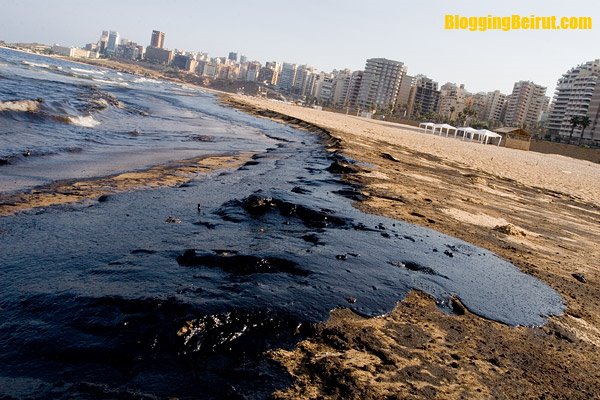
About 10,000 tons of oil from the tanks of the Jiyeh power plant bombed by Israeli aircraft now pollute about 40 miles of the Lebanese coast threatening to affect the entire coast extending onto the Syrian coast and beyond. Another report states that the spill now extends 60 miles. Enviromental groups agree that this is the largest enviromental disaster that Lebanon has faced.
The New York Times also reports on the severe air pollution and forest fires caused by Israel's unrelenting bombing campaign.
Yet more convincing evidence that the Israeli government's intention was not the destruction of the whole of Lebanon, just Hezbollah.
Thursday, July 27, 2006
Civilians? What Civilians?
Here is a mind bending rationalization by Alan Dershowitz of Israel's indiscriminate attack on civilians. This is from the same person who suggested that shooting to kill a Palestinian teenager throwing stones at Israeli soldiers is justified and that the village from which a suicide bomber originates should be raised to the ground as a form of collective punishment. I learned of this article from the comment of an Israeli blogger who describes herself as someone working for peace and understanding in the Middle East but who praised the article! And I thought only Arabs suffered from self-delusional thinking.
'Civilian Casualty'? It Depends
Those who support terrorists are not entirely innocent.
(Los Angeles Times, July 22, 2006)
By Alan Dershowitz,
THE NEWS IS filled these days with reports of civilian casualties, comparative civilian body counts and criticism of Israel, along with Hezbollah, for causing the deaths, injuries and "collective punishment" of civilians. But just who is a "civilian" in the age of terrorism, when militants don't wear uniforms, don't belong to regular armies and easily blend into civilian populations?We need a new vocabulary to reflect the realities of modern warfare. A new phrase should be introduced into the reporting and analysis of current events in the Middle East: "the continuum of civilianality." Though cumbersome, this concept aptly captures the reality and nuance of warfare today and provides a more fair way to describe those who are killed, wounded and punished.
There is a vast difference — both moral and legal — between a 2-year-old who is killed by an enemy rocket and a 30-year-old civilian who has allowed his house to be used to store Katyusha rockets. Both are technically civilians, but the former is far more innocent than the latter. There is also a difference between a civilian who merely favors or even votes for a terrorist group and one who provides financial or other material support for terrorism.Finally, there is a difference between civilians who are held hostage against their will by terrorists who use them as involuntary human shields, and civilians who voluntarily place themselves in harm's way in order to protect terrorists from enemy fire.These differences and others are conflated within the increasingly meaningless word "civilian" — a word that carried great significance when uniformed armies fought other uniformed armies on battlefields far from civilian population centers. Today this same word equates the truly innocent with guilty accessories to terrorism.The domestic law of crime, in virtually every nation, reflects this continuum of culpability. For example, in the infamous Fall River rape case (fictionalized in the film "The Accused"), there were several categories of morally and legally complicit individuals: those who actually raped the woman; those who held her down; those who blocked her escape route; those who cheered and encouraged the rapists; and those who could have called the police but did not.No rational person would suggest that any of these people were entirely free of moral guilt, although reasonable people might disagree about the legal guilt of those in the last two categories. Their accountability for rape is surely a matter of degree, as is the accountability for terrorism of those who work with the terrorists.It will, of course, be difficult for international law — and for the media — to draw the lines of subtle distinction routinely drawn by domestic criminal law. This is because domestic law operates on a retail basis — one person and one case at a time. International law and media reporting about terrorism tend to operate on more of a wholesale basis — with body counts, civilian neighborhoods and claims of collective punishment.But the recognition that "civilianality" is often a matter of degree, rather than a bright line, should still inform the assessment of casualty figures in wars involving terrorists, paramilitary groups and others who fight without uniforms — or help those who fight without uniforms.Turning specifically to the current fighting between Israel and Hezbollah and Hamas, the line between Israeli soldiers and civilians is relatively clear. Hezbollah missiles and Hamas rockets target and hit Israeli restaurants, apartment buildings and schools. They are loaded with anti-personnel ball-bearings designed specifically to maximize civilian casualties.Hezbollah and Hamas militants, on the other hand, are difficult to distinguish from those "civilians" who recruit, finance, harbor and facilitate their terrorism. Nor can women and children always be counted as civilians, as some organizations do. Terrorists increasingly use women and teenagers to play important roles in their attacks.The Israeli army has given well-publicized notice to civilians to leave those areas of southern Lebanon that have been turned into war zones. Those who voluntarily remain behind have become complicit. Some — those who cannot leave on their own — should be counted among the innocent victims.If the media were to adopt this "continuum," it would be informative to learn how many of the "civilian casualties" fall closer to the line of complicity and how many fall closer to the line of innocence.Every civilian death is a tragedy, but some are more tragic than others.
'Civilian Casualty'? It Depends
Those who support terrorists are not entirely innocent.
(Los Angeles Times, July 22, 2006)
By Alan Dershowitz,
THE NEWS IS filled these days with reports of civilian casualties, comparative civilian body counts and criticism of Israel, along with Hezbollah, for causing the deaths, injuries and "collective punishment" of civilians. But just who is a "civilian" in the age of terrorism, when militants don't wear uniforms, don't belong to regular armies and easily blend into civilian populations?We need a new vocabulary to reflect the realities of modern warfare. A new phrase should be introduced into the reporting and analysis of current events in the Middle East: "the continuum of civilianality." Though cumbersome, this concept aptly captures the reality and nuance of warfare today and provides a more fair way to describe those who are killed, wounded and punished.
There is a vast difference — both moral and legal — between a 2-year-old who is killed by an enemy rocket and a 30-year-old civilian who has allowed his house to be used to store Katyusha rockets. Both are technically civilians, but the former is far more innocent than the latter. There is also a difference between a civilian who merely favors or even votes for a terrorist group and one who provides financial or other material support for terrorism.Finally, there is a difference between civilians who are held hostage against their will by terrorists who use them as involuntary human shields, and civilians who voluntarily place themselves in harm's way in order to protect terrorists from enemy fire.These differences and others are conflated within the increasingly meaningless word "civilian" — a word that carried great significance when uniformed armies fought other uniformed armies on battlefields far from civilian population centers. Today this same word equates the truly innocent with guilty accessories to terrorism.The domestic law of crime, in virtually every nation, reflects this continuum of culpability. For example, in the infamous Fall River rape case (fictionalized in the film "The Accused"), there were several categories of morally and legally complicit individuals: those who actually raped the woman; those who held her down; those who blocked her escape route; those who cheered and encouraged the rapists; and those who could have called the police but did not.No rational person would suggest that any of these people were entirely free of moral guilt, although reasonable people might disagree about the legal guilt of those in the last two categories. Their accountability for rape is surely a matter of degree, as is the accountability for terrorism of those who work with the terrorists.It will, of course, be difficult for international law — and for the media — to draw the lines of subtle distinction routinely drawn by domestic criminal law. This is because domestic law operates on a retail basis — one person and one case at a time. International law and media reporting about terrorism tend to operate on more of a wholesale basis — with body counts, civilian neighborhoods and claims of collective punishment.But the recognition that "civilianality" is often a matter of degree, rather than a bright line, should still inform the assessment of casualty figures in wars involving terrorists, paramilitary groups and others who fight without uniforms — or help those who fight without uniforms.Turning specifically to the current fighting between Israel and Hezbollah and Hamas, the line between Israeli soldiers and civilians is relatively clear. Hezbollah missiles and Hamas rockets target and hit Israeli restaurants, apartment buildings and schools. They are loaded with anti-personnel ball-bearings designed specifically to maximize civilian casualties.Hezbollah and Hamas militants, on the other hand, are difficult to distinguish from those "civilians" who recruit, finance, harbor and facilitate their terrorism. Nor can women and children always be counted as civilians, as some organizations do. Terrorists increasingly use women and teenagers to play important roles in their attacks.The Israeli army has given well-publicized notice to civilians to leave those areas of southern Lebanon that have been turned into war zones. Those who voluntarily remain behind have become complicit. Some — those who cannot leave on their own — should be counted among the innocent victims.If the media were to adopt this "continuum," it would be informative to learn how many of the "civilian casualties" fall closer to the line of complicity and how many fall closer to the line of innocence.Every civilian death is a tragedy, but some are more tragic than others.
Subscribe to:
Posts (Atom)