Thursday, August 28, 2008

Mixed Marriage: A Insider's View


In a recent blog post, Abu Fares skillfully outlined for Betty the issues that need to be considered to make an intercultural marriage a success. The post made me think about my own parents. Mixed marriages generally get bad press as the media focuses on sensational stories of relationships gone horribly wrong. Given this negative image, if my parents' story appears unremarkable to me -they are my parents after all- theirs is a story of success and is perhaps a story worth recounting.

Fifty two years ago, a young Syrian physician, doing a year of post-doctoral training in London, met a young European woman who was in London to learn English. They fell in love. My father, not wanting to be hemmed in by his family's choice of suitable future spouses, proposed to my mother. Before they returned to Syria, they went to get the blessing of her parents. My father, won over my grandmother with his Levantine charm. My grandfather, on the other hand, could not swallow the fact that his daughter was marrying an Arab. Though he did not stand in the way of their union, his attitude never changed. Upon seeing me and my brother a couple of years later, he told my mother that we were not as brown as he expected us to be! He, unfortunately passed away shortly thereafter and I regret never to have been able to know him better.

Arriving in Lattakia of the mid 50s was a cultural shock for my mother. She was received with open arms by my long-widowed paternal grandmother and my father's nine uncles and aunts, an open-minded and highly educated bunch embraced her easily. But Lattakia was a small, parochial and conservative town and the the arrival of a foreign bride certainly set the tongues wagging. Her unusual parenting methods, she followed the Dr. Spock school of parenting, was the talk of the neighborhood. They noted with amusement my mother's penchant for using colored plates to increase her children's finicky appetite. The ladies of the حارة (neighborhood) were scandalized that the doctor's boys were playing, dressed in nothing but their underwear ( شحّارن they are going to "catch" a cold!), in the tiny wading pool my mother had put in our small garden.

It took my mother time to adapt to this new social environment. The support of the extended family made the transition much easier as was the support of a handful of other European women from mixed marriages living in town. My parents' relationship remained solid in spite of my father's increasing religiosity. To his credit, my father never imposed his religiosity on my mother or used it to limited her in any way. Soon, however, their lives would be turned upside down by external upheavals beyond their control. With my father's involvement in politics, we moved to Damascus. The subsequent political unrest of the early sixties made it difficult for us to stay in Syria and the family decamped -in haste- to Lebanon. There, the more open and liberal social atmosphere offered my mother respite from the more restrictive public sphere in Syria. Simple pleasures like going swimming became possible again. On the other hand, Lebanon, with its schizophrenic identity problems, could at times prove to be uncomfortable for my mother, married as she is to Muslim Syrian. To her annoyance, some Lebanese, who fancied themselves more European than Middle Eastern, felt at liberty to share with her all of their prejudices against "les Arabes"; all within earshot of her four boys.

For the next three decades, Lebanon would become the home base of a nomadic family existence as my father, working for an international organization, was posted in various developing countries. In an attempt to provide us with a stable education my parents enrolled us at first in boarding schools in Lebanon and we would rejoin our parents abroad on holidays and in the summer. This often proved too difficult a separation for my mother who would return to Lebanon to stay with us for months at a time. Eventually, to preserve family unity, we abandoned our schooling in Lebanon and followed my father in his various postings. Though my parents' relationship was strained and severely tested, especially at times when they were separated, it survived. Fifty two years on my parents remain inseparable.

The success of a marriage, whether within or across cultures, comes down to the compatibility of the partners. Any relationship requires, in addition to love, a willingness to compromise, a give and take to reach a balance that is acceptable to both. In an intercultural marriage the spouse who ends up living in a new culture will have to make additional compromises. Of course, how much compromise is required depends on the how accomodating the culture is. Certainly modern day Lattakia is a very different place than Lattakia of the 50s. But Lattakia, a coastal Levantine city, even in the 1950s was more accomodating than a place like modern day Saudi Arabia, outside of the artificial foreign enclaves, with its imposed homogeneity.

But mixed marriages are not only about compromises. Exposure to new a new culture is greatly enriching for both. Moreover, for a resourceful spouse, like my mother, access to the ethos and morals of two divergent cultures came in handy in keeping us, her children, in line. She might, for example, become indignant if our behavior offended her European sensibilities in some way. Yet she could in an instant turn the tables on us and act like the most conservative Lattakia mother chiding us for some other behavioral misstep. The conservative Lattakia mother is the face she yielded when it came to her sons' relationships with the opposite sex. She would advise us about "nice"girls whom she thought appropriate for us. When we made our own choices, she acted like the typical Arab mother, jealously protecting her "precious" sons from unworthy women. Um Kareem was on the receiving end of some of that wrath although I am happy to say that she is now, thank god, the favorite daughter-in-law.

Whether intercultural marriages especially European-Middle Eastern unions are any less successful than other marriages is difficult to say. After reading Abu Fares' post I put that question to my mother, knowing that she is not one to mince words. She said that in almost all marriages that she has known between Syrian men and European women, the men married for true love and remained loyal to their wives even when the realtionship faltered for other reasons such as difficulties with the husband's family or the inability of the wife to adapt to Syrian culture.
Of course, the couples my mother knew may not be representative. Nevertheless it clearly shows that such marriages can succeed and prosper. And if they offer greater challenges at the start, they also offer greater rewards when they do succeed.

Monday, August 25, 2008

Shehadeh's Palestinian Walks


When it comes to the Palestinian-Israeli conflict, Western opinion is greatly influenced by cultural and religious biases, collective post-Holocaust guilt and a narrative of the conflict that is almost exclusively that of Jews living in the West. In addition, with the passage of time, a clear-eyed view of the root of the conflict is increasingly muddied by intervening world and regional events, and more recently, by internecine Palestinian conflicts. Yet, when pared down to its bare-boned essentials, there is stark, simple and undeniable reality to the conflict: The deliberate, planned, systematic dispossession of Palestinians of their land which continues unabated sixty years into the conflict. That reality, clear as day to most Arabs –and I might add, most of the rest of the world-, still does not seem to register with most Westerners. Raja Shehadeh’s book, Palestinian Walks, goes a long way into refocusing the attention of its readers to the realities of Israel’s intentions.

Shehadeh is a lawyer and human rights activist who spent decades trying to defend Palestinian lands from expropriation by Israel. In Palestinian Walks, Shehadeh, an avid walker, recounts several of his most memorable walks through the unique Palestinian landscape in the past three decades. As we go along with him on his walks, we learn much of the geology of Palestine as well as its flora and fauna. We also learn about the intricate relationship between this land, its history and its people through stories of his own extended family. He goes on to poignantly describe the devastating changes in the Palestinian landscape brought on by the settlements, the bypass roads and most recently Israel’s “security” wall. Throughout his walks Shehadeh reflects back on his struggles as a lawyer trying to defend Palestinian land from expropriation. He describes in great detail the systematic way in which Israel thwarted local and international laws to steal Palestinian land and expel its rightful owners. He exposes as a bold faced lie Israel’s contention that settlements were built only on “public” lands in the Occupied Territories. Shehadeh’s wrath is not limited to Israel though. He rails against the PLO and its failure to include the settlements in the Oslo accord, an omission that he feels has had disastrous consequences. All that Arafat was interested in, he contends, is Israeli recognition of the PLO.

Much of what Shehadeh exposes is not new; it can be found in many more scholarly books and magazines. The value of Shahedeh’s book, with its seemingly innocuous title and low key style, is that it brings the stark reality of Israel’s machinations to the general (Western) public. This is not second hand recounting of dry facts but first hand information from a man who is intimately involved. Moreover, what makes this book so powerful is the juxtaposition of the personal anecdotes from someone with a deep love of the land, with the hard facts. What also comes through in some of the anecdotes is the mindset of the “other”, the settlers and those in Israel and outside who empower them. Take, for example, this anecdote about a Palestinian farmer most of whose land was confiscated for building a settlement and what was left of his house and property was fenced in except for a passageway a few yards wide. Now the wall threatened to cut him off from his village and the houses he built for his children:

Sabri and I were standing outside in the sun looking at the settlement through the wire fence built around his house. He was telling me about this latest case when we saw an old man walking his Labrador on the other side of the fence. I tried hard to catch the man’s eye. I wanted some indication of how he felt confining his neighbor in this way, but the man would not raise his eyes from the ground. He went solemnly through his walk, keeping pace with his dog, never showing recognition of Sabri or his guest.”

When I read this and think of the Western media’s accepted narrative of the Israeli as the perpetual victim and the Palestinian as the perpetual aggressor, it is hard not to get angry. Is there any more need to explain Palestinian rage? to answer the question of "why do they hate us?" when Barack Obama deems it only wothwhile to visit Sderot and not the thousands of Palestinians who suffered the same fate as Sabri and when Sarkosi says that the creation of the state of Israel was the greatest thing that happened in the 20th century?

As you delve further into the book, Shehadeh’s mood grows from melancholic to despondent as he realizes that his life’s work, that of trying to protect Palestinians from Israel’s seemingly insatiable appetite for other people's land was a failure. At one point, as his father once did, he briefly thinks of suicide. Some of the gloom lifts towards the end of the book as Shehadeh’s perspective changes. He has to force himself to admit his failure, the defeat of this phase of the struggle for Palestine, to enable him to move on. He also learns the virtue of patience as he realizes that while most men measure their accomplishment in the time scale of a lifetime, history follows not such time scale.

Shehadeh’s clearly thinks that Israel's current policies, disastrous as they are for the Palestinians, will ultimately doom Israelis as well. Although he does explicitly spell it out, you get the sense that he believes as did Edward Said, late in life, that the ultimate solution is a one state solution. The one state solution is gaining traction among more and more prominent Palestinians although it remains anathema to the vast majority of Israelis. I have come around to believe the same although I do not see how it will ever become acceptable to enough Israelis to make anything more than a pipe dream.

Thursday, August 07, 2008

Step 1: Aref Dalilah's Release


Mohannad al-Hassani, Dalilah's lawyer, said upon his release:

"We hope that this will be the beginning of freedom for the rest of the prisoners of conscience in Syria."

I couldn' agree more. I am a hopeful person by nature and will not speculate about the motive for his release, hoping -against all odds- that this is not political maneuvering or some quid pro quo to placate some foreign leader, like Monsieur Sarko, par example. Oops, I speculated!! Whatever the reason, it is a good first step and hope that it becomes a trend.

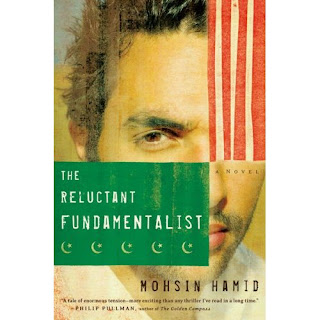
On Hamid's Reluctant Fundamentalist

"THEY hate our freedom!", "THEY want to destroy our way of life!", "THEY love death more than they love life!", "Islamofascits this and Islamofascists that....". These and other like-minded statements permeated the airwaves and newspaper headlines during the early post 9/11 frenzy. There was talk, by otherwise reasonable people, of internment camps and mass expulsions. Paranoia and xenophobic patriotism electrified the air and made every Arab and Muslim living here retract in fear, concern and anger. We all wondered how far this will go and whether we should pack our bags and leave.

Changez, a highly successful immigrant and the protagonist of Hamid's novel, chose to leave. Mohsin Hamid's intriguing novel is a monologue by Changez as he entertains an American visitor to dinner at a Lahore restaurant. Changez, a Pakistani immigrant, recounts his years in America starting as an ambitious student at Princeton, on to success in the rarefied air of a Manhattan valuation company. Then 9/11 transpires and things start to unravel. He becomes disenchanted with post-9/11 America and feels torn and guilty about being away from his family in Lahore as Pakistan and India, with American collusion, edge towards war. He thinks of returning home. His mind is made up when on an business assignment in Chile, a book editor compares Changez, a soldier in a high temple of the American capitalist empire, to an Ottoman Jannisary . Changez returns to Pakistan where he becomes a vocal critic of American foreign policy.

Early on in the novel, we learn that the American visitor is not a guest but is there in some official capacity. Tension builds as we learn that the American is uneasy and suspicious. We get a distinct feeling that something ominous is about to happen but Hamid's deft storytelling leaves us guessing to the end. In fact we are left guessing at the novel's abrupt end as to what exactly happened. Perhaps it is a statement by Hamid about the murky and yet unresolved state of affair between East-West, seven years after the start of the open-ended "war on terror".

Through the monologue Hamid answers the question that Americans keep asking: "why do they hate us?". Hamid's response is not an angry polemic but a subtle, intelligent explanation. It is the fact that the United States is, whether Americans want to admit it or not, the world's economic and military bully. American by and large see themselves as moral and decent individuals but there is a fine line between moral rectitude and condescending, self-absorbed, self-righteousness. America's asymmetric response to 9/11 is one manifestation of this syndrome.

Seven years on, the tide of mindless flag waving is slowly turning -slowly. This book was published in 2007 to uniformly good reviews. Yet I bought it from a bookstore a couple of weeks ago from a pile of deeply discounted books, an indication that it is not selling well. It is too bad, this book should be widely read by Americans. I guess it is more reassuring to read a book by pseudo-experts reassuring you of your moral superiority and confirming that the enemy is more vile than Satan, than to read a book that holds a mirror up to your face and shows you all the warts and wrinkles that you would rather forget.

Monday, July 21, 2008

Kuntar: Hero or anti-Hero?

I don't think he is either.

Let's get real. Kuntar was a minor at 16 years of age, when he was sent by the FLP on the Nahariyah operation in 1979. I do not pretend to know what his motives were or whether this was an idea implanted by adults into the impressionable mind of a sixteen year old. He is after all a Lebanese Druze and not a Palestinian whose family suffered violence and dispossession at the hands of Israel; so personal anger and rage are unlikely to have motivated him.

I wanted to stay out of this debate altogether but the way Kuntar is being treated like a celebrity has left me more than a little queasy. I am annoyed with the way many Arabs have reflexively accepted his promotion to icon of the resistance and are willing to gloss over the facts that have brought him to his iconic status.

I know for certain that many who will publicly support him, have privately the same uneasy feelings I do about this whole affair but are willing to suppress it in favor of the big picture: That the prisoner exchange was a victory over Israel. These very same people when confronted with the facts of the Nahariyah operation will, instead of responding to the accusation, remind you of Israel's long list of atrocities against civilians, including children. No objections here except that two wrongs don't make a right. Others will tell you that the child bludgeoning accusation is an Israeli fabrication, that the child died in the crossfire. I do not know the veracity of the claim but even if true, it does not get him off the hook since neither the child nor the child's parents should have been put in that situation in the first place. I, for one, cannot accept that this act perpetrated against civilians is a legitimate act of resistance. There are no buts here; we, as Arabs, undermine our legitimate grievances against Israel's many acts of barbarity if we then turn around and excuse similar acts perpetrated by one of our own. More importantly, we undermine our own integrity.

The real resistance heroes in my book are the Hizbullah fighters who fiercely and valiantly battled the Israeli army forcing its exit in 2000, or the youngsters of the intifada who battled fire with rocks and slingshots. My iconic figure of resistance is the young Palestinian fighter who in the summer of 1982 in Beirut, was standing alone on the back of pickup truck manning an antiaircraft gun. He was one of few fighters left standing on an exposed highway by the Beirut stadium (Madineh el Riyadiyeh) surrounded by death and destruction, yet he kept firing at unrelenting waves of Israeli fighter jets until he was felled by an Israeli missile. They are heroes because they fought unselfishly and with courage. Their actions were purposeful in that they confronted the immediate cause of their problems, the armed aggressors.

The point is the Nahariyah operation and other operations targeting civilians undertaken by the Palestinian resistance during that era were purposeless in that they never advanced the cause of the Palestinian resistance and I would argue that, in many instances, it set it back. Hizbullah did not liberate the South by staging operations against civilian targets in Israel; they did it by making life hell for the IDF in the South.

I do not know the histories of the other four prisoners released along with Kuntar or the stories of the nearly two hundred deceased fighters, but I bet that more than a few will have stories much more befitting a hero than that of Samir Kuntar.

Tuesday, July 15, 2008

On Qunfuz's "The Road From Damascus"


When I learned that Qunfuz (Robin Yassin-Kassab) had published his first novel, I just had to read it. A few clicks on my keyboard and it was making its way from Amazon.UK. The book arrived at my doorstep from across the Atlantic in four days!

Anyone who reads Robin's blog knows what a talented writer he is. I still remember the first post of his that I read. What impressed me most was not so much his writing style but the anecdote and the insights it gave me about the writer. The post was about the time he spent at a meditation retreat somewhere -I believe- outside London. Here was a man, I thought, with a wide intellectual horizon; someone, with a clear orientation on the larger issues of life but yet not someone stuck on a rigid ideological track. I have read most of his posts since. They have served to confirm my initial impression but also provided me with further insights into his thinking on a range of issues including politics, religion and identity. I have not necessarily always agreed with his ideas but his thoughts were never presented in a strident and dogmatic manner; there was always room for an alternate view and for all the shades of grey in between. It also became clear, on reading his posts, that he was an exceptional writer.

The Road From Damascus deals with issues of faith, secularism, identity and politics among Arab immigrants in that overheated melting pot that is modern-day London. Those are all issues that have preoccupied all Arabs individually and collectively for much of the second part of the 20th century and into the present. It is, however, among Arab immigrants living in the West, straddling the fault line of the East-West divide, where these issues are most intensely felt and where there is a sense of urgency in defining an identity lest others define it for them. These feelings were particularly acute during the decade of the 90s leading to 9/11, the time frame covered by this novel.

The novel explodes dense with ideas and thoughts, a reflection, I suspect, of Robin's hyperactive mental ferment. Perhaps there was enough material for more than one novel compressed into this single book. Stylistically, the writing evolves with the story. It starts at a frenetic pace, with short, brusque -often one word- sentences packed with abstract imagery, symbolism and allusions. It takes getting used and it left me, at times, mentally exhausted. Perhaps it is because this book reached deep inside my psyche and pulled me in. I am a generation older than the protagonists yet I, like them, continue to struggle with issues of identity and faith. I am resigned to the fact that this may be a never ending quest, struggle, jihad for the truth -as it probably should be. In the last third of the novel the writing is noticeably more relaxed and the sentences longer despite the fact that the world around the protagonists was getting crazier. This change, purposeful or not, appeared to mirror Sami's mental transformation as he sheds his father's rigid, uncompromising secularism and reconciles with his wife and the reality of the world around him.

Novels, especially ones dealing with intimate subjects like faith and identity tend to be, to a degree, autobiographical. Reading Robin's blog, it is clear that many of the ideas that preoccupy him reappear as preoccupations of the some of the novel's protagonists. In fact as I read the detailed description of Sami's facial features early on in the novel, I flipped to the back of the book searching the jacket flap for a picture of the author; the physical similarities were striking. Moreover, at the risk of being wrong, I suspect that there might be some of Robin in Muntaha's Sufi-infused Islam.

It goes without saying that I highly recommend this book for anyone interested in an in depth and uncompromisingly clear-eyed handling of many of the controversies that roil the Arab and Muslim world. But, just as importantly, it is a story well told and beautifully written. Robin alternates between original, symbolic, fantastical turns of phrases to graphic realism that overloads your sensorium. He brings to life places and persons with an uncanny eye for detail. He knows his Arabs and he knows his Brits of all colors a persuasions and he knows them intimately. The book starts with a dark and pessimistic outlook of the world and ends on a much more hopeful note as the main protagonist finds inner balance in his life despite a world that is anything but in balance around him.

Sunday, June 29, 2008

Obama's Young Supporters are Better than Him!


As the presidential election nears, Obama is going through the usual gyrations, twists and turns necessary to please as many voters as possible. In other words, with every passing day, he looks more and more like the off-the-shelf slimy politician that he claimed he is not. So, the candidate who claims to prefer diplomacy over conflict is suddenly ready to go "Nukular" against Iran on Israel's behest. More disturbing, is his response to Muslim-by-association campaign mounted by xenophobic, fear-mongering right wing opponents. Instead of facing the prejudice head on, he is in fact succumbing to it. To those who raise the question of his faith ad nauseaum, he could choose to tell them that the question is irrelevant. Instead, he dutifully repeats, that he is a church going Christian. Moreover, in our instant YouTube world, his campaign obsessively blocks any image or word that "taints" him with anything Muslim. To this end, they removed from camera range, two veiled supporters who were invited to his rally in Detroit and disinvited a Muslim congressman from attending another. And somehow, whereas right wing televisions commentators never forget to mention Obama's middle name, usually pronounced slowly and deliberately for emphasis, you will not see the name Hussein mentioned anywhere on Obama's own website.

It is refreshing then to see young Obama supports, not tied down by the older generation's built-in biases, informally adopting Hussein as their middle name as way of making an important point. It may seem gimmicky, but given the negative gut reaction the name engenders in a -not insignificant- portion of the American electorate, it is a bold and important point to make, one that should have been made by the candidate himself.

Wednesday, June 18, 2008

A Syrian Hakeem in America

In 1986, life had become intolerable in Beirut. The Lebanese civil war, in one of its innumerable permutations had made life miserable. The future looked bleak and I had reached a crossroads in my professional life. I was a young physician who had long aspired to become a neurologist, the brain and its complexity having captured my imagination early in my university years. But there was no neurology training programs in Lebanon. Besides, even though I had spent years in Lebanon, as a Syrian, I would not be allowed to practice in Lebanon when my training was complete. It did not matter that I had lived longer in Lebanon than in Syria and that I cared for the place despite the fact that I would always be the -Syrian-neighbor that everyone loved to hate. I had little choice but to leave and jumped at the first chance I got for an internship in the United States.

America was a familiar place to me having spent my college years here several years before. Yet despite that, the transition was not easy. The calm, order and predictability of my new life in the U.S. was jarring after living seven years of chaos and civil war. There was a sense of guilt at having "abandoned", in a time of turmoil, a place I cared for. The professional transition was easier. My AUB training prepared me well for the way medicine is practiced in the United States. It also helped that most of the resident trainees at the community hospital I initially worked at were also AUB graduates and that we often, to the dismay of the medical director, conducted patient rounds in Arabic!

There were, needless to say, other challenges along the way that necessitated perseverance and a thick skin. Perhaps the biggest challenge is that of overcoming the label of being a foreign medical graduate. It is like a Scarlet letter sewn to your back that marks you as suspect as far as the quality of your training and your competence and you always have to work twice as hard to prove your worthiness. Over time, as you finish your training and prove your competence, the scarlet letter fades and you are finally accepted as an equal among your peers. Nevertheless, it leaves an indelible mark on your psyche. Even now, long after my being a foreign medical graduate has ceased to matter, I bristle in anger at derogatory comments about foreign doctors. More than once, I heard the director of our training program, in my presence, grumbling that he might have to "settle" for a foreign medical graduate if he unable recruit an American graduate. Program directors would rather settle for a less competent American graduate than have the reputation of their training program sullied by the presence of a foreign medical graduate.

Another challenge for a foreign doctor is anticipating how your patients will respond to you. You are, after all, the doctor who looks different and has a funny name. In fact this turns out not to be much of a challenge. Most ordinary Americans could care less where you came from as long as they thought you competent and you treated them with respect. In many ways they were less biased than professional colleagues. Most of those who are curious enough to ask where I am from, look blankly when I tell them I was Syrian. You get responses like "I remember reading something about Damascus in the Bible" or from a patient who learned from the morning headline of trouble "over there" and kindly inquires "how is your family doing in Palestine?" despite my having told him that I was Syrian on several occasions. Few are not geographically challenged and handful are surprisingly well informed. One elderly man in his nineties would ask me at each visit about Assad the eye doctor. He thought that Bashar was a handsome man (?!!). Overtly hostile patients were few and far between. One such patient who was referred to me, launched into a tirade of insults on hearing my name when he called for an appointment. It took the secretary several calls before she convinced him that I am the right person to see. He looked at me suspiciously on his first visit, but I disarmed him by pretending not to know what transpired prior to the visit and treated him like any other patient.

America prides itself for being a land that rewards competence and hard work. I dare say that for me, and I suspect for most foreign born and trained doctors, this is largely true. Americans in positions of power are, by and large, capable of dissociating their personal biases and preferences from their professional lives. The chair of my department is a born again Christian with a very close-minded view of anyone not like him. Yet, I never felt that this fact ever figured in his assessment of the quality of my work or his willingness to promote me.

In the end, my experience as a hakeem in America had less to with my being Syrian and everything to do with my being a physician. As much as the patients I cared for over the years have provided me the experience that solidifies my medical competence, they have also provided me with even richer life experience. Illness is the great equalizer, it strips you of all that defines you as a healthy, functioning individual. It is in this naked and vulnerable state that a person comes to you for help and few human relationships are as intimate or as intense.

Saturday, June 07, 2008

Genuflect and Kiss the Ring


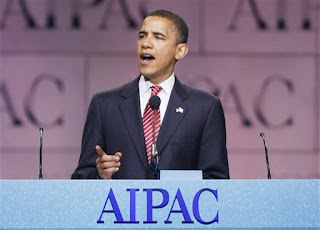
Obama as with Clinton and McCain had to make the obligatory pilgrimmage to the annual AIPAC meeting if they want to have a chance at the presidency. The pandering is enough to make one nauseous. This satirical video from Jon Stewart's show says it all.

Tuesday, June 03, 2008

Kaffiyeh-gate

Rachel Ray is a television celebrity chef with an irritatingly spunky manner and an annoying voice. Today though, I just feel sorry for her. After she appeared in this Dunkin Donuts commercial wearing what seems to be -Gasp!!!- a kaffiyeh, all hell broke loose and Dunkin Donuts was forced to hastily retract the advertisement.

Why? Because various right-wing commentators accused the hapless Rachel of: wearing Jihadi chic, of promoting hate, of promoting Muslim extremism and terrorism of being insensitive to Israelis...Intifada...Palestinian terrorism... and on and on and on... All because of a scarf? and if you look closely, it is not even a Kaffiyeh.

Arabs and Muslims living in the United States for the past seven years have had to develop a thick skin. We are constantly bombarded with this type of ignorant garbage and it seems to be unrelenting as the years go by. Xenophobic hysteria was to be expected in the immediate aftermath of 9/11 but not a single American has been killed on American soil since then because of Al Qaeda-linked terrorists. In contrast, tens if not hundreds of thousands of innocent civilians have died since in retribution in ill-conceived and unnecessary wars. And yet, seven years on, the constant barrage of fear-mongering drivel continues.

As an Arab and a Muslim it hits you in the face everywhere you turn from newspapers, to the web, the radio and TV. Bookstore tables seem to always feature one or two new alarmist books about terrorism or Islamic extremism by self-proclaimed experts. Authors who cannot read a word of Arabic will expound confidently about fatwas, hadiths or the meaning of Koranic verses. And at
a time when the reverend Wright is excoriated about his politically incorrect speech about white people and the reverend Hagee is criticised about his anti-Jewish speech, no one blinks at the overtly xenophobic anti-Arab and anti-Muslim opinions that permeate all forms of media.

Sometimes I feel like I need to create a MEMRI in reverse. Let's call it AMRI (American Media Research Institute). MEMRI's purpose is to translate selections from the Arabic media to "expose" to the West its intolerant, hate-filled and anti-Western content. I propose doing the same by translating into Arabic the hate-filled, ignorant and Islamophobic content of American media. The difference is, whereas MEMRI has to dig deep into more obscure sources to get their juicy content, all AMRI has to do is turn on the TV, grab the closest newspaper or walk into a bookstore to find the incendiary material that it needs.

Monday, June 02, 2008

Off with his Headshots


I don't know much about Michel Suleiman except that he looks like a bland bureaucrat. Not that it is a bad thing, Lebanon could use some blandness right about now. However, with this story, I am seeing him in a whole new light. Imagine that, an Middle Eastern leader who is actually asking that pictures and posters of him be taken down!!! This is truly revolutionary. I hope our regions other kings, presidents for life, emirs and other self-annointed leaders take note; it is no about you but about the people you are supposed to serve.

Sunday, June 01, 2008

The Visitor: A Glimpse of Post 9/11 America


The Visitor is ostensibly a movie about the transformative power of a chance meeting between two very different individuals. Yet within this universal tale, the director, Tom McCarthy, also exposes the corrosive effects of the post 9/11 paranoia on certain aspects of American society. In this land of immigrants, empathy and fairness towards (most) immigrants has been replaced by cold antipathy and a place where fear, no matter how illogical, trumps human and civil rights as well as common decency. This hardening of attitudes is most palpably felt by those of the "wrong" faith or ethnicity.

Walter is an Anglo-Saxon, middle-aged college professor of global economics. He is the prototype of an American with a privileged existence. He is also a widower who is bored with the monotony of his life and work. On a trip to New York City for work, he finds Tarek, a young Syrian musician and Zeinab, his Senegalese girlfriend living in his apartment, rented to them illegally by a swindler. They apologize and get set to leave when Walter offers to let them stay until they can find a place of their own. During that time Walter befriends Tarek who teaches him to play the African drum. A failed piano player, Walter is taken by the joyful rhythm of the African drum.

When Tarek is arrested by overzealous transit cops and disappears into the bowels of the Kafkaesque post 9/11 privately run security detention facilities, Walter is introduced to a world from which he, as a privileged white native-born American, he was completely unaware of. Walter hires a lawyer to help Tarek. Within days, Tarek's mother, unable to reach him by phone, arrives at the door of Walter's apartment from Michigan. As they both seek Tarek's release, a romantic bond develops between the two. You will have to see the movie for the rest of the story.


This is a gem of a movie. There is nothing Hollywood about it. It is a human story, beautifully told in a slow, deliberate and realistic way. Closeup shots of the actors reveal every wrinkle on their faces making them all the more expressive. Best of all, the movie is, thankfully, free of Arab Hollywood stereotypes.

The acting is exceptional especially by the beautiful Palestinian actress Hiam Abbas (The Syrian Bride) who played Tarek's mother and Richard Jenkins who played Walter.

Saturday, May 31, 2008

Opinions on Syrian-Israeli Peace Talks at Creative Syria

Alex at Creative Syria has managed to get a good mix of Syrian and Israeli opinions on the recent announcement of Syria-Israeli negogitiations. Here is my contribution.

(Photo: Fraom Carter Center website)

Wednesday, May 21, 2008

A Disagreement Among Brothers...No Longer

Every year, in Spring, my brother, who lives and works in Beirut, comes to the United States for a professional meeting then swings by to spend a few days with us. This year his visit coincided with the latest spasm of violence in Lebanon and so he was stuck here for an extra week.

He was, of course, worried about his family back in Beirut; but the upside was that I and the kids got to spend more time with him. There was however, palpable tension between us whenever we discussed the politics of Lebanon. My brother got quickly wound up and passionate during these discussions especially when I disagreed with him. Once an admirer of Rafik Hariri, he has, over the past few years, come to unconditionally support the opposition; and that is where we defer. My brother's politics are gut level and emotional and are molded mostly by his visceral reactions to a certain segment of Lebanese society.

He hated the way the Beirut Spring demonstrations of 2005 turned into an open ended slur of everything Syrian as, once again, the Lebanese blame someone else for all their shortcomings. But what gets my brother really angry is the deep seated arrogance, hypocrisy and hateful sectarianism manifested by a not insignificant number of Lebanese. Add to the mix a screwed up sense of identity, and you get the psychopathology encapsulated by this statement he overheard recently at a dinner party: "Ya'ni moi, je ne peu pas vivre avec les Shiites". Mind you, this statement, in perfect Franbanais, was uttered by a Sunni from Ras Beirut! Go figure!

Although I share his revulsion of certain -many- aspects of Lebanese society, I fail to understand his complete and uncritical support of the opposition. I listened and learned from him but failed to alter his views. It is easy for me to dispassionately analyze Lebanese politics from a distance. But for him, stuck in the middle of the overheated and poisonous cauldron of Lebanese politics, he feels forced to take sides.

His departure yesterday left me a little sad as we were unable able to bridge our differences. But overnight, our differences have become irrelevant. Before he landed back in Beirut, the Lebanese politicians had finally managed to do the right thing for their people and not only themselves. Moreover, and the timing is hardly a coincidence, Syria and Israel announce that they have been talking peace.

May 21, 2008 is a day to savor. I will, for the moment, purge any last vestige of skepticism and cynicism from my being to enjoy a day when sanity and hope, commodities nearly extinct in our corner of the world, seem to have taken hold... at least for a day.

Saturday, May 17, 2008

Best Sign of the Week


I couldn't agree more with this message from members of Lebanon's Association for the Disabled to their leaders as they left Beirut airport for Qatar. This sign cuts through the mountains of manure that each side heaps on the other and gets down to the heart of the matter.

Saturday, May 10, 2008

Hizb Should Disband its Militia

I do not typically feel the need to make any disclosures before I speak my mind, but when it comes to discussions about Hizbullah, many otherwise reasonable people have rigid, unchangeable impressions that defy what the facts actually reveal. My older brother and I generally agree on most political issues but we diverge radically when it comes to the issue of Hizbullah. I am a Sunni Muslim who despises sectarianism in any form. Having lived in Lebanon for years, I am also fully aware of the historical disadvantage of the Shia when it comes to the established Lebanese social and economic pecking order. I used to cringe when I heard a Lebanese Sunni or Christian refer to Shia in a derogatory manner. But I also know very well that sectarianism cuts both ways, especially when one particular sect feels it has the upper hand; all you have to do is look at Iraq.

I have little sympathy for most of the March 14 politicians but my anger today is directed squarely at Hizbullah and Nasrallah. Many of us, because Hizbullah managed to deliver a black eye to the Israeli army in the summer of 2006, seem to be willing to overlook their transgressions or question their political motives. But I cannot escape the fact that, no matter how you slice it, the presence of an independent militia, armed to the teeth, that is accountable to no one is an unsustainable and destabilizing situation in a sovereign state. The repeated claims, that the arms are only for protection against Israel, ring hollow, especially in the last twenty four hours with Nasrallah’s bombastic threats of civil war if he does not get his way. What has become abundantly clear is that the arms and the militia are to be used as leverage for Hizbullah's political aspirations. The formula is clear: We will ask softly but if you don't do as we say, we'll bring our men into the streets. Moreover we will sack and burn the media outlets that we don't like because we think they are lying as if Al Manar is a bastion of journalistic integrity and objective reporting.

Hizbullah got deservedly high marks for its resistance to the Israeli occupation whose withdrawal they forced in 2000. Hizbullah could have leveraged the gratitude of most Lebanese at the time to turn itself into a formidable political machine. Why didn’t they incorporate their militia into the Lebanese Army then and become a purely political party? They would have been in an excellent position to advocate for their constituency and they would have transformed the national Lebanese army into a formidable fighting force truly capable of protecting Lebanon's southern borders. Moreover, they could have diverted their seemingly limitless flow of cash away from supporting and arming a militia to improving the well being of their community. All other militias from the civil war were dissolved following the Taef agreement, why should Hizbullah have a free pass after 2000? Some will dispute that last statement but clearly the recent rearming of some of these militias was in response to the perceived threat from Hizbullah . Besides, as the pitiful showing of Mustaqubal's militia demonstrates, none of these armed groups can compare in scale and equipment to the standing army that Hizbullah has. However, given a couple more years of Lebanese turmoil, the situation will be akin to that of 1975 and a full fledged civil war will be a certainty.

Many non-Lebanese support Hizbullah because of its successful confrontations with Israel . They see it more as an abstraction, as a the bastion of "resistance" against the encroachment of Israeli designs and American Neocon aspirations. They seem to overlook the fact that Hizbullah's existence as an autonomous militia erodes the viability of Lebanon as a state. It is as if Lebanon is a disposable sacrificial lamb on the altar of regional and global power struggles. It is telling that those same supporters of Hizbullah would balk at the very thought of having a parallel autonomous militia within their own country that does not feel obligated to follow the laws of the land. The Syrian government is guilty of this type of blatant hypocrisy. If they were true believers in "resistance" politics, why don't they invite Hizbullah to the Golan Heights?

Lebanon needs and deserves peace after more than three decades of strife. It has, more than any other Arab state, established institutions of a working, albeit corrupt, democracy. There is no reason why Hizbullah with its large constituency and tremendous resources cannot work within the political system to its advantage within the need of a militia. The biggest threat to Israel is not a militia in a weak divided state, but a stable, successful Lebanon capable of defending itself and capable of competing with it economically and intellectually.

What Would Nasrallah Tell Sahar?

I watch neither Future TV nor LBC but listening to Sahar's angry and emotional tirade is heartbreaking. Clearly, there is more than one side to the story but Hizbullah and its supporters have much to answer to regarding what happened in the last several days.

Friday, May 09, 2008

Why?

This is the day I had feared for a long time but hoped would never materialize. The images of masked young men all hyped up by the deranged and false ideologies of their leaders, all too eager to sow death and destruction, is like a recurring nightmare from years gone by. Only now, the black and white images have given way to moving images, broadcast in real time and in living color and assault your senses from every TV and computer monitor. The images are depressing, nauseating and fill me with shame and hopelessness.

The images also make me angry. I blame every last Lebanese politician who has willingly played the role of puppet, pimp and whore to one or more foreign master; every last one of them, from Berri to Jumblatt, to Gaegea, to Hariri Jr to Nasrallah, to Aoun. Their primary goal has always been self preservation and the preservation of their power and that of their narrow constituencies. None of them, despite their lofty public pronouncements, ever worked for the interest of Lebanon and the Lebanese people as a whole.

Why did it have to come to this? Why? Have they not learned a damn thing from the civil war? Perhaps if the powers that be had not behaved like the civil war was someone else’s problem and the young generation had been taught about the war in school, they would have realized the civil war’s absurdity and its devastating consequences.

Perhaps then, those masked young men would not be holding on to those Kalashnikovs with such lust, with such eagerness to finger the triggers and draw blood, the blood of their brothers and sisters.

Sunday, May 04, 2008

Nakba: In the Words of the Perpetrators

The media blitz to commemorate Israel's 60th anniversary (see previous post) continues without so much as a peep as to what actually happened in 1948. So here is my own miniscule attempt to counter that onslaught. I know that most readers of this blog do not need to be reminded of the tragedy of the Nakba, so this post is for those who stumble onto this blog and who think Israel is infallible. For those folks, please note: these are not the words of some "overheated", "irrational" Arab mind, but the words of the founder of the state of Israel. David Ben Gurion to Zionist official Nahum Goldmann:

"Sure, God promised it to us, but does that matter to them? There has been anti-Semitism, the Nazis, Hitler, Auschwitz, but was that their fault? They only see one thing: We have come here and stolen their country." (as recounted in 1948: A history of the first Arab-Israeli war, by Benny Morris)

(Photo: From 1948.org.uk)


Wednesday, April 23, 2008

Golan Cowboys and Other Israeli Myths

So as the 60th anniversary of the Nakba approaches and Israel readies to celebrate its sixty years of existence, the Turks tell us that Israel is prepared to return the Golan Heights for peace with Syria.

Perhaps no one told Israel's ministry of tourism of the upcoming plans. A couple of weeks ago, the add above appeared as a two-page spread in the New York Time Sunday Magazine. "You'll love Israel from the first Shalom" states, unconvincingly, the advertisement featuring a cowboy atop a horse in a wide open, golden wheat field with green hills on the horizon. Shave his beard and stick a Marlboro in his mouth and this could be Montana... Trouble is, this lush farmland is not Israel, it is in the Golan Heights and the cowboy is nothing more than a settler usurping Syrian land. Does Mr. cowboy-settler look like the type of person who will surrender "his" 1000 acre farm for peace?

But the add doesn't stop there. At the lower right hand side, and without a hint of irony, it states: "Israel, No one belongs here more than you"!!! Really? I guess someone should spread the good news to the reufugees of Nahr el Bared, Ein el Helweh, Shatilla ...